Unnikrishnan K’s Employee of the Year Journey
Growth often begins when you’re trusted to take on more than what’s expected. For Unnikrishnan, that shift at Cubet came through ownership, working across varied projects, and the freedom to make decisions that mattered. In this conversation, he shares how that trust, along with strong teamwork and continuous learning, shaped his journey from delivering features to confidently owning solutions end to end.
Q: You’ve recently been recognized as Employee of the Year. How did that moment make you feel, and what did it make you reflect on?
It was honestly a surprise. When I heard about it, my first reaction was gratitude rather than pride. I’ve been associated with Cubet for the last two and a half years, and from day one, what stood out to me was the friendly atmosphere within teams.
The trust they place in us makes a big difference. It never feels like we’re just completing assigned tasks; instead, the project starts to feel like it’s ours. Being involved in understanding the outcome of the end product, not just the implementation, is what makes the work truly satisfying for me. Over the years, I’ve worked with multiple teams, and I’ve always seen a strong willingness to communicate and learn from one another. That positive energy naturally pushes you to grow. The confidence that project managers show in us also helps; it allows us to work independently and take responsibility for what we build. Looking back, this recognition made me reflect on how much I’ve grown at Cubet, from executing features to becoming an engineer who feels confident building and owning solutions end to end.
Q: How has the way you approach your work changed since joining Cubet?
Before joining Cubet, I was working in a product-based company. When I decided to move to a service-based organization, a few friends warned me that the transition might be difficult. That was also my first role as a developer in a product company, so naturally I had some doubts myself.
However, from the time I joined Cubet, my perspective started changing. I got the opportunity to be part of multiple projects and work with different teams, domains, and technologies. This exposure pushed me to think beyond a single product or codebase and focus more on adaptability, problem-solving, and learning quickly.
Today, I approach my work with a broader mindset, understanding requirements faster, choosing the right solution based on context. Looking back, this experience has helped me a lot in shaping my career and made me more confident as an engineer.
Q: Looking back, what experience at Cubet contributed most to that change?
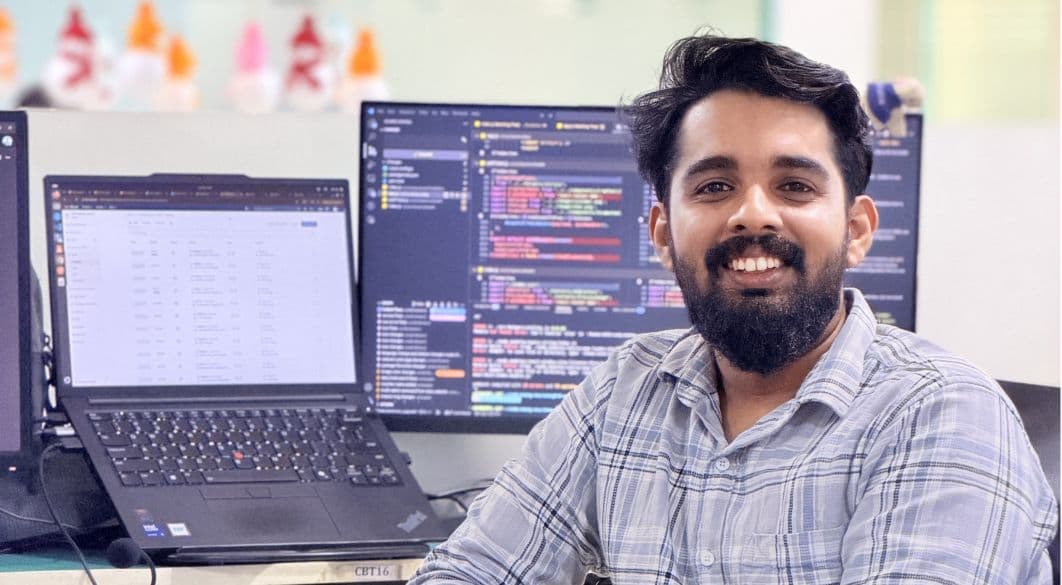
One of the biggest contributors to that change has been the variety of projects I’ve worked on at Cubet. For a significant period, I was deeply involved in a project where we are building a learning ecosystem for Africa, which helped me understand how to build and scale a complex system over time.
Alongside that, I also got opportunities to work on very different projects including a hospitality platform, HRMS platform, AI chatbots, and many admin panels. Each project came with its own challenges, users, and expectations. Working across these domains pushed me to learn continuously and adapt quickly. It helped me think beyond a single use case and improved the way I design features, understand business requirements, and make technical decisions. Overall, this exposure played a major role in shaping how I approached my work today.
Q: When is “good enough” better than “perfect,” and when is it not in software engineering?
In software engineering, timelines are always important, and at the same time, I strongly believe that “good enough” should never mean compromising quality. Being part of a long-term project has taught me that decisions made today stay in the system for years. For core features, architecture, and areas that impact scalability or maintainability, striving for the right and well-thought-out solution is critical.
Working on both long-term products and shorter projects at Cubet has helped me understand where to draw that line, move fast where you can, but be deliberate where it truly matters.
Q: Do you believe speed or craftsmanship matters more in modern software delivery, and has your view changed over time?
Earlier in my career, speed felt more important, delivering features quickly and meeting expectations was the primary focus. Over time, especially through my experience at Cubet, that view has evolved. As I mature, I started understanding the long-term impact of the code we write. Speed is definitely important in modern software delivery, but without proper craftsmanship, it often leads to rework, technical debt, and instability later.
Today, I believe the real value comes from balancing both, moving fast where possible, while still maintaining clean, readable, and maintainable code. This balance is something I’ve gradually learned through experience, and it has made me a better and more responsible engineer.
Q: What matters more about strong engineering teams, deep individual expertise or shared ownership?
Deep individual expertise is valuable, but without a strong team and shared ownership, even the best individual cannot truly grow or succeed. From my experience at Cubet, teamwork is one of the biggest advantages for better growth — both professionally and personally. When teams share responsibility, communicate openly, and support each other, it creates an environment where individuals feel confident to contribute, learn, and improve. That collective ownership helps deliver better solutions and also makes the work more meaningful.
At Cubet, I’ve seen how strong teams bring out the best in individuals, and that balance is what ultimately drives long-term success.
Q: Has AI genuinely made engineers more productive yet, or are we still overestimating its impact?
These days, many developers are worried about job loss because of AI. From my perspective, AI is more of a helper than a replacement. It assists us with daily tasks and helps us build features faster, especially by reducing repetitive work and speeding up problem exploration. That said, relying entirely on AI can affect our learning and problem-solving skills. Understanding the logic behind what we build is still critical, and that responsibility cannot be delegated to tools.
I see AI as something that supports engineers rather than replaces them. When used in the right way, it helps us improve productivity and focus more on meaningful engineering decisions.
Q: What excites you most about what lies ahead for you at Cubet?
What excites me most is the opportunity to work on future projects and continue growing by taking on new challenges. Each new project at Cubet brings a different set of requirements, technologies, and learning opportunities, which keeps the work interesting and motivating. Overall, I see Cubet as a place where I can keep learning, adapting, and contributing meaningfully to the work we do together.
Explore. Learn. Grow.
Unnikrishnan’s journey reflects how meaningful growth often happens through everyday work, shared responsibility, and the freedom to learn along the way. It’s this environment of trust and collaboration that continues to shape how teams grow at Cubet.
Have a project concept in mind? Let's collaborate and bring your vision to life!
Connect with us & let’s start the journey
Share this article



Get in touch
Kickstart your project
with a free discovery session
Describe your idea, we explore, advise, and provide a detailed plan.