
Building reliable healthcare software leaves little room for shortcuts. Every feature needs to be tested. Every edge case needs attention. And as development cycles move faster, repetitive testing and documentation can quietly consume the time engineers need for higher-value work.
We wanted to see whether AI-assisted software development could change that equation—reducing repetitive effort while keeping engineering quality and human oversight firmly in place.
The Challenge: When Testing Starts Taking Time Away From Engineering
The team was midway through developing a healthcare platform when we took a closer look at where development time was going.
A significant portion of every sprint was being spent on test generation: writing unit tests, creating validation cases, preparing API test scenarios, and maintaining regression coverage.
The work was necessary. It was also repetitive.
At the same time, sprint estimation was becoming less predictable. Actual effort was averaging 1.4× the planned hours, creating a 40% overrun and making downstream planning increasingly difficult.
The issue wasn't engineering capability. It was identifying where intelligent automation could remove repetitive effort without removing engineering judgment.
So we set out to measure what AI could actually improve.
The Approach: Introducing AI Into the Development Workflow
As part of Cubet's Phase 1 AI adoption programme, the healthcare project became one of three pilots for introducing AI-assisted development workflows.
But we didn't start with AI.
We started with evidence.
First, We Established a Baseline
For one week, the team worked as usual while we measured:
- Test generation time
- Documentation effort
- Debugging time
- PR review time
- Sprint estimation accuracy
This gave us a clean manual baseline against which the impact of AI could be measured.
Only then did we introduce AI into the workflow.
Then, We Added AI Where It Made Sense
From week two, developers began using GitHub Copilot Business to support test scaffolding, generate test data, and create first drafts of API test scenarios.
Claude and ChatGPT through Open WebUI supported SRS preparation, user story drafting, and sprint estimation.
The principle was simple:
Automate the repetitive. Keep the judgment human.
Every AI-generated output was reviewed by a senior engineer or PM before it was used. No exceptions.
This created a controlled AI-ready development workflow rather than replacing the existing engineering process.
The Results: Less Repetition. More Predictable Delivery.
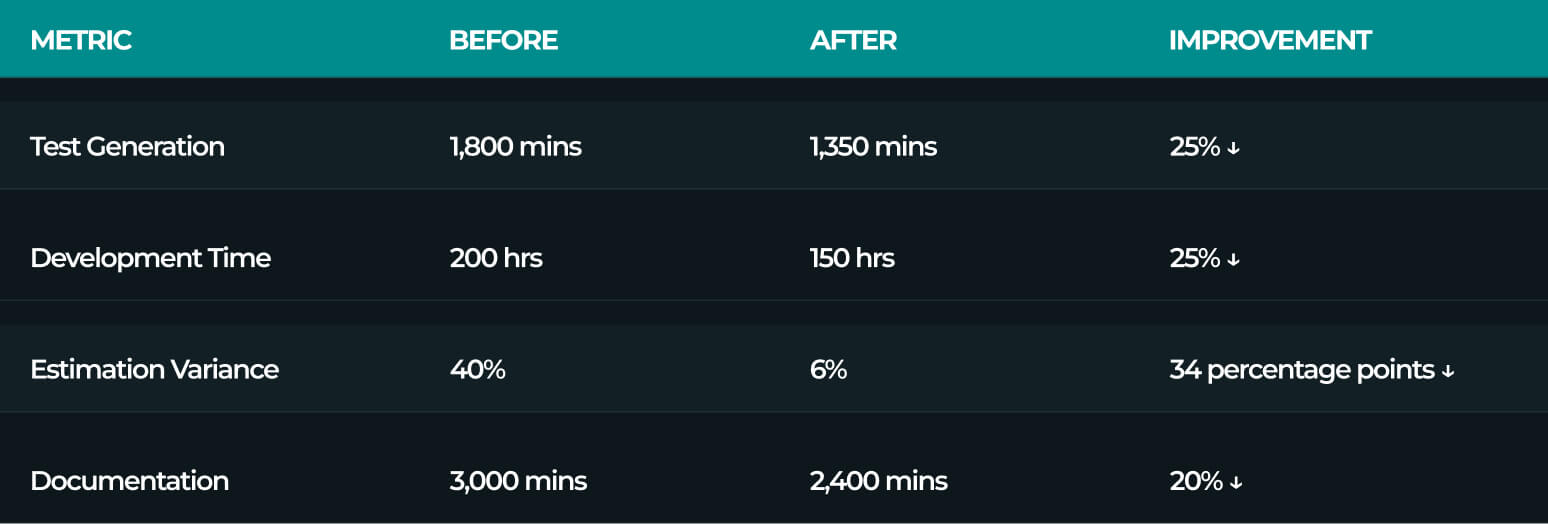
Over four weeks of structured tracking, the pilot showed measurable improvements across the development workflow.
25% Less Time Spent Generating Tests
Test generation dropped from 1,800 to 1,350 minutes.
The team maintained the same quality and test coverage while spending significantly less time on scaffolding and repetitive test creation.
AI handled the first layer of repetitive work. Engineers remained responsible for the logic, validation, and final quality.
25% Less Development Time
Average development effort dropped from 200 hours to 150 hours per sprint, while sprint throughput remained stable.
The team was delivering the same scope with less time spent on repetitive development activities.
Estimation Variance Fell From 40% to 6%
One of the most significant changes wasn't in coding at all.
Sprint estimation variance reduced from a 40% overrun to just 6%.
That gave the team greater predictability in planning and helped reduce the uncertainty that often follows complex software delivery.
20% Less Documentation Effort
Documentation time reduced from 3,000 to 2,400 minutes.
Another example of where AI could support repetitive work while engineers retained responsibility for accuracy and context.
What We Learned: AI Works Best Inside the Workflow
The pilot revealed three lessons that extend beyond test generation.
01. Measure Before You Automate
Without the Week 1 manual baseline, we would only have had opinions about whether AI helped.
With the baseline, we had evidence.
For teams adopting AI, measuring the existing workflow first creates a much clearer picture of where intelligent process automation can actually deliver value.
02. Human Oversight Is Part of the System
Every piece of AI-generated output—from test code and documentation to user stories—was reviewed before being used.
The result wasn't AI replacing engineering.
It was AI working inside an engineering workflow, with people remaining accountable for quality.
03. The Impact Goes Beyond the Individual Task
Saving 450 minutes on test generation doesn't mean the benefit ends there.
A test created earlier can catch a bug earlier.
A more predictable estimate can make sprint planning easier.
Less repetitive work can give engineers more time to focus on test logic and higher-value technical decisions.
The individual metrics only tell part of the story.
What This Means for Healthcare Software Development
Healthcare software demands a higher bar for quality, reliability, and validation. The cost of getting something wrong can be significant, which makes responsible AI adoption especially important.
This pilot showed that AI-assisted software development can improve engineering efficiency without compromising quality, when supported by the right validation and review processes.
By reducing repetitive work, engineers can spend more time on the parts of software delivery where human expertise matters most.
The result is not simply faster development.
It is a more intelligent, predictable, and AI-ready approach to healthcare software engineering.
AI in the workflow. Not AI replacing the workflow.



Get in touch
Kickstart your project
with a free discovery session
Describe your idea, we explore, advise, and provide a detailed plan.