
Quick Summary
Lease audit is a field where a single wrong number can sink a recovery claim. So when a leading commercial real estate technology company asked us to automate the way auditors process lease documentation, the brief wasn't just "make it faster." It was "make it fast and legally defensible."
We built an AI-powered document intelligence platform that ingests up to 1,000 mixed documents per engagement, classifies each one automatically, extracts the fields that matter using Azure OpenAI GPT-4o, and, critically, scores every extracted value for confidence before it reaches an auditor. The system is designed to know what it doesn't know.
The result: document preparation that previously consumed days of manual sorting and data entry now completes in hours. Auditors review only the fields the system flags as uncertain rather than reading every page of every document, compressing the time from document receipt to audit-ready data and letting the firm take on more engagements with the same team, with a defensible evidence trail behind every figure.
The Client
A leading commercial real estate technology company offering a SaaS platform for lease audit tools, training, and tenant-centric cost analysis. Their users are professional lease auditors who process enormous volumes of lease documentation to recover overcharges on behalf of commercial tenants, work that has historically run on paper, spreadsheets, and manual cross-referencing.
The company came to us to change that: to give their platform an AI-powered document intelligence layer that automates document understanding, turns unstructured lease files into structured audit data, and lets auditors scale their work without scaling manual effort.
The Problem: 1,000 Documents, No Structure, No Room for Error
Every engagement arrived the same way: a bulk upload of hundreds to thousands of files (leases, amendments, invoices, CAM statements, rent rolls) completely unsorted, in wildly inconsistent formats. Before a single audit calculation could happen, someone had to sort that pile, figure out how each amendment related to its master lease, and key the relevant terms into a system by hand.
Three things made this genuinely hard to automate:
The stakes are legal, not just operational.Lease audit findings support recovery claims and dispute resolutions. An incorrectly extracted financial term, base year election, or cap structure that slips into a calculation unchecked isn't a typo; it's legal and commercial exposure. Any automation had to surface its own uncertainty rather than fail silently.
Commercial leases have no standard format. Different landlords, property types, and jurisdictions produce documents with different terminology, clause ordering, and layouts. Amendments make it worse: they override specific clauses in the master lease, often without signposting what changed. The system had to understand not just what a document says, but how documents relate to and supersede each other.
A large share of source documents were scans, not digital files. Rotated pages, blurry text, image-based PDFs, handwritten annotations: every OCR weakness at the scanning stage flows directly downstream into the reliability of the audit itself.
Manual processing at this scale was unsustainable. But naive automation that extracts everything and trusts everything is worse than the manual process, because it inherits errors silently.
The Solution: A Pipeline That Knows What It Doesn't Know
We built the platform around a five-stage extraction pipeline. Follow a single engagement through it:
Stage 1: Bulk upload
Up to 1,000 files land in a single upload. Queue management and background job processing absorb the volume without timeouts, and failure isolation means one corrupted PDF never stalls the other 999. Retry logic handles transient failures at the document level automatically.
Stage 2: Automated classification
Before anything is extracted, GPT-4o identifies what each document is (lease, amendment, CAM statement, invoice, rent roll) and routes it to the correct extraction schema. This is a deliberate architectural choice: classification is a discrete, auditable pipeline stage, not an assumption buried inside extraction. Extract the wrong fields from a misidentified document and the audit inherits the error silently; identify correctly first and every downstream stage stands on solid ground.
Amendments get special treatment here. The system links each amendment to its master lease, tracks modification history, and resolves conflicting clauses across versions, maintaining a single accurate picture of each lease's current terms. This eliminated a whole category of error that manual review consistently missed at volume.
Stage 3: AI field extraction
Document-type-specific prompting pulls exactly the fields that matter for audit (financial terms, base year elections, expense recovery clauses, cap structures) and maps them to standardized database fields. Scanned documents pass through OCR processing built to handle rotated pages, blurry text, and handwritten annotations, so non-digital source material doesn't degrade the pipeline.
Stage 4: Confidence scoring
This is the stage that makes the platform audit-grade rather than merely automated. Every extracted field carries a confidence score, surfaced directly in the review interface. High-confidence values can be approved in a single action. Low-confidence values are flagged for correction before they can enter any calculation. The system doesn't pretend to certainty it doesn't have; it tells the auditor exactly where to look.
Stage 5: Human review
The auditor stays in control of every conclusion. Reviewers work in a collaborative interface with role-based access, threaded discussion and annotation on individual fields, and searchable HTML renderings of each source document that preserve formatting and clause structure. Every action (extraction, comment, approval, status change) lands in a comprehensive audit log.
Real-time dashboards run across the whole pipeline, giving auditors and managers live visibility into extraction progress, batch status, and failures, replacing the manual check-ins that were previously the only way to know where an engagement stood. Validated data then flows into management reporting and client-ready output: expense validation, recovery calculations, and exception reporting.
Under the hood: semantic search across the full document corpus via a FAISS vector database (OpenAI text-embedding-ada-002 embeddings) lets auditors locate clauses and cross-reference terms across leases and amendments instantly. LangChain's QA chain and recursive text splitting keep extraction reliable regardless of document length. Encrypted storage and transmission via AWS S3, authenticated API access, and role-based permissions protect commercially sensitive tenant and landlord data throughout. The whole architecture is modular: new document types and extraction schemas plug in without structural changes.
The ROI
Days of manual preparation, reduced to hours of automated processing. Sorting, data entry, and cross-referencing previously consumed a major share of every engagement before analysis could begin. That work is now automated end to end, so auditors start with review-ready data instead of a document pile.
Review effort focused where it matters. Instead of reading every document in full, auditors concentrate on the fields the system flags as low-confidence. High-confidence extractions are approved in one click. The result is substantially compressed turnaround from document receipt to audit-ready data.
More engagements, same team. Faster turnaround directly increases capacity: the firm can take on a higher volume of audit work without adding headcount, which is the core commercial return on the investment.
Audit-grade defensibility preserved. Every figure in every finding traces back through a validated extraction, a confidence score, an auditor approval, and a logged decision. Automation didn't weaken the evidence trail; it strengthened it.
A category of error eliminated. Systematic amendment linking and version resolution catch clause conflicts that manual review reliably missed at volume.
Zero-babysitting batch processing. Engagements of up to 1,000 documents run without the constant monitoring and intervention high-volume handling used to demand; dashboards surface the exceptions, and only the exceptions.
Before / After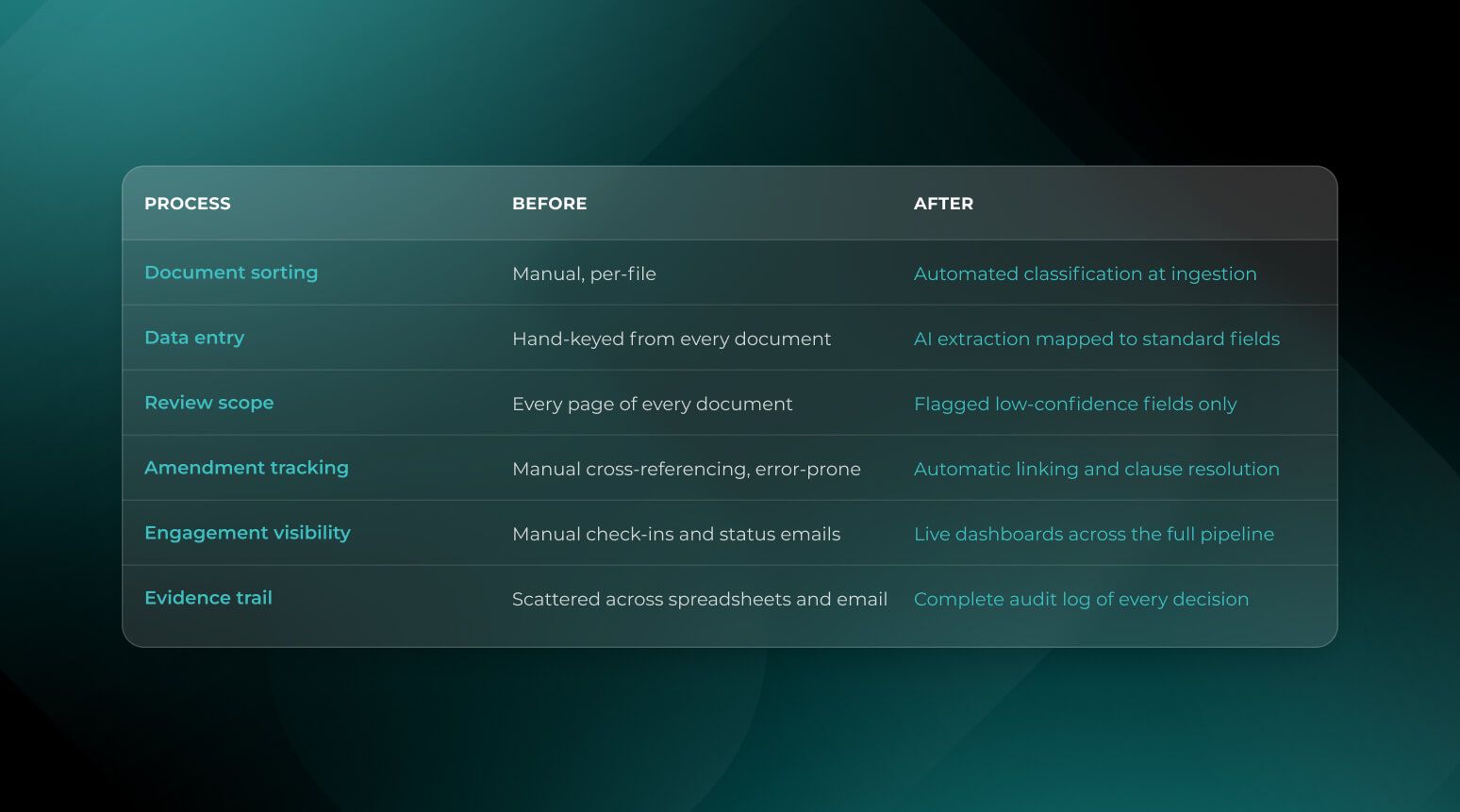
Built to Grow
The modular pipeline accommodates new document types, expanded extraction schemas, and additional reporting without structural rebuilding. As the firm's audit scope grows, the platform grows with it: the foundation scales instead of constraining.



Get in touch
Kickstart your project
with a free discovery session
Describe your idea, we explore, advise, and provide a detailed plan.