When Growth Begins to Strain Your Laravel Platform: And Why Preparing for Intelligence Is Becoming a Business Priority


Over the past few years, many digital product teams have quietly arrived at the same realization.
Their platform works. Customers rely on it. The core functionality delivers real value. In many ways, the product has matured exactly as intended. Yet something begins to feel different as the business grows.
Reports take longer to load than they once did. Background jobs queue up during peak hours. Integrations that once felt seamless begin to introduce delays. Security and compliance considerations become more complex with every new customer and region.
None of these issues appear suddenly. They surface gradually, almost subtly, as usage grows and data accumulates. Then a new conversation enters the room.
The team wants to introduce analytics, automation, or AI-driven capabilities. They see competitors moving in that direction. Customers are beginning to expect smarter experiences. Leadership sees opportunities for efficiency and differentiation.
And that’s when hesitation appears.
Will our platform handle this?
Will performance degrade?
Will security risks increase?
Are we about to open a door we can’t close?
This moment, more than any technical limitation, is where many product teams find themselves today.
Laravel Built the Product. Growth Is Testing Its Assumptions
Laravel has earned its place as a trusted foundation for SaaS and digital platforms because it enables teams to build quickly, maintain clarity in code, and ship reliable functionality.
Most products, however, were designed around the needs that existed at the time: transactional workflows, predictable workloads, and clear functional outcomes. They were not designed to process large volumes of analytical data in real time. They were not built to support intelligent automation pipelines. They were not optimized for AI-assisted decision systems.
That wasn’t a flaw. It simply wasn’t the requirement. But the requirements have changed.
The Market Has Shifted from Functionality to Intelligence
There was a time when solving a specific problem well was enough.
Today, users expect software to do more than store data and execute tasks. They expect systems to surface insights, automate repetitive work, and adapt to how they operate.
Customers increasingly want to know:
What should I do next?
Where are the inefficiencies?
What patterns are emerging?
How can this process be automated?
In other words, they are looking for intelligence, not just functionality. This shift is subtle but profound. It transforms software from a tool into a decision-support system. And that transformation changes the demands placed on the platform beneath it.
What This Looks Like in Practice
Consider a B2B SaaS platform that started with a few hundred customers and a straightforward data model. The Eloquent queries were clean, the dashboards loaded instantly, and the team shipped features with confidence.
Three years later, the database holds 18 months of transactional history. The reporting page now pulls across multiple joined tables for every dashboard load. Background jobs for email sequences, invoice processing, and integration syncs are all competing for the same queue workers during morning peak hours. A simple date-range filter that once returned results in 200ms now routinely takes four to six seconds.
Nothing is broken. But nothing feels fast anymore either. And when the product team proposes adding an AI-driven recommendations engine, the response from engineering is cautious: “we’d need to sort out some infrastructure things first.”
This is the pattern. The platform hasn’t failed — it has simply grown into a new phase that the original architecture wasn’t designed to handle. Recognizing that distinction is the first step toward addressing it constructively.
Warning Signs Your Platform Is Ready for the Next Phase
Not every team will recognize these signals immediately, because they tend to appear gradually rather than all at once. The following indicators are worth paying attention to:
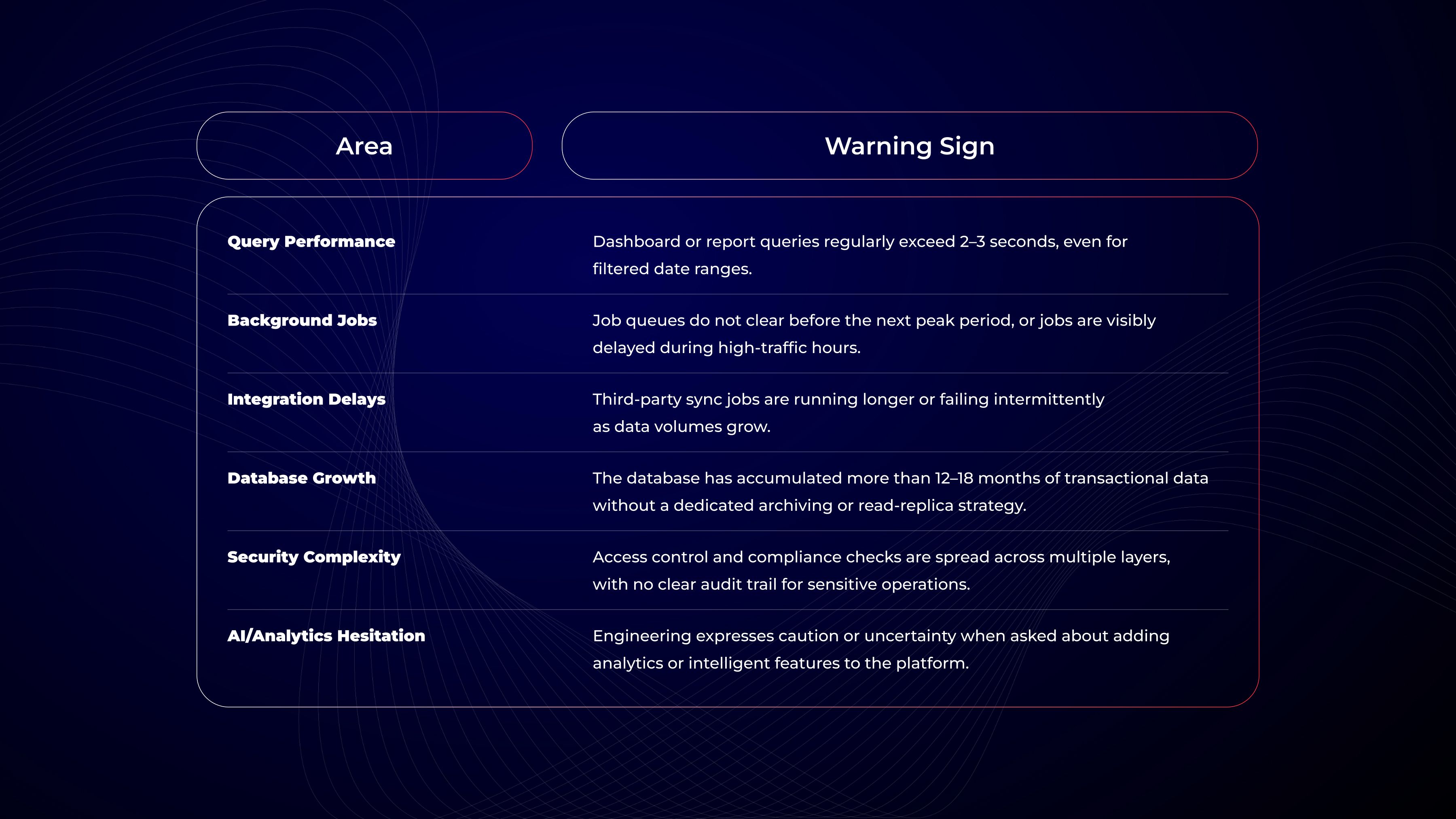
Why Performance Strain Emerges as Platforms Mature
Performance issues are rarely the result of poor engineering. More often, they reflect growth.
As a platform evolves, the nature of its workload changes. Data accumulates. Reporting becomes more complex. Integrations multiply. Users expect real-time responsiveness rather than periodic updates. Security and compliance requirements add layers of verification and access control. Automation workflows increase background processing demands. Analytics and AI initiatives introduce entirely new data processing requirements.
None of these changes are problematic in isolation. Together, they create pressure on an architecture designed for a different phase of the product lifecycle. This is when teams begin to notice friction. Not failure, but friction.
The Hesitation Around AI Adoption Is Not About AI
When teams hesitate to introduce AI-driven capabilities, the concern is rarely about the value of intelligence. It is about readiness.
AI depends on data integrity, performance reliability, and secure access patterns. It requires platforms to handle increased processing loads and maintain responsiveness under more complex workloads.
If these foundations are fragile, introducing intelligence can amplify existing weaknesses rather than delivering value. This is why many product teams pause, even when they see the opportunity clearly.
The Myth of the “Inevitable Rebuild”
One of the most persistent fears founders express at this stage is the belief that scaling and evolving the platform will require starting over. The logic is understandable. Rebuilding feels cleaner than modifying a system that customers depend on daily.
Yet in practice, a complete rebuild is rarely necessary. Laravel platforms, when thoughtfully structured, are highly adaptable. What is often required is not replacement but refinement — identifying where workloads have changed and strengthening those areas to support the next phase of growth.
This distinction matters. Rebuilding introduces disruption and risk. Refinement preserves stability while enabling evolution.
What Evolution Actually Involves
When platforms begin to show signs of strain, the path forward is typically less dramatic than teams fear.
Performance improvements may come from optimizing data access patterns and caching strategies. Background processing can be refined to handle automation workloads more efficiently. Architectural adjustments may be introduced where responsibilities have expanded beyond original assumptions.
Data flows can be structured to support analytics without degrading transactional performance. Security controls can be strengthened to meet growing compliance needs without introducing unnecessary latency. Infrastructure can be tuned to handle peak loads with resilience.
None of these changes require rewriting the product. They reflect a platform maturing alongside the business it supports.
Preparing for Intelligence Is Preparing for the Future
Introducing analytics, automation, and AI-driven capabilities is not a technical upgrade. It is a shift in how the platform supports decision-making and operational efficiency.
For intelligence to enhance a platform rather than strain it, the underlying system must support efficient data movement, reliable performance, and secure access to sensitive information. When these foundations are in place, intelligence becomes an extension of the platform’s value. Without them, it becomes a source of friction.
This is why preparation matters more than implementation.
The Founder’s Balancing Act: Stability and Evolution
Founders often carry a quiet tension at this stage. The platform works. Customers depend on it. Stability feels non-negotiable. Yet the market is evolving. Competitors are introducing automation and insights. Customers are beginning to expect more intelligent interactions. Internal teams see opportunities to operate more efficiently.
The challenge is not whether to evolve. It is how to evolve without disrupting what already works. This is not a technical decision. It is a strategic one.
A Practical Way to Begin: Platform Readiness Assessment
For many teams, the first step is not transformation but understanding. The questions below form a simple readiness framework. Answering them does not commit the business to change — it provides the clarity needed to make evolution deliberate rather than reactive.
Performance Readiness
Where do queries or jobs begin to slow under load? Can you identify the top three bottlenecks today?
Are there caching opportunities in high-traffic read paths that are currently uncached?
How does the system behave when two or three concurrent peak events happen simultaneously?
Data Architecture Readiness
Is there a clear separation between transactional data flows and analytical/reporting data flows?
How does data move through the platform today? Are those flows documented?
What would be required to feed clean, reliable data to an AI or analytics layer without degrading responsiveness?
Security and Compliance Readiness
Where might security and compliance requirements introduce risk as the system scales to new regions or customer segments?
Is there a clear audit trail for sensitive operations today?
How would access patterns need to change to safely support AI or automation systems operating on sensitive data?
The Quiet Shift Underway
Software is moving beyond delivering functionality. It is becoming an intelligence layer that helps organizations operate more effectively. Platforms that evolve thoughtfully will support this shift. Those that remain static will feel increasing friction as expectations change.
Laravel remains a powerful foundation for this evolution when supported by the right architectural refinements.
A Closing Thought
If your platform is beginning to show signs of performance strain, scaling complexity, or uncertainty around introducing intelligent capabilities, you are not alone.
This is not a sign that something is broken. It is a sign that your product has grown. And growth invites evolution. The path forward is rarely disruptive. It begins with understanding, followed by thoughtful refinement, and continues with steady progress toward a more intelligent and resilient platform.
Work with Cubet
At Cubet, we work with product companies navigating this exact phase — helping them strengthen performance, improve data readiness, and evolve their platforms to support intelligence, automation, and growth without disrupting what already works.
We offer a Platform Readiness Assessment — a focused architecture review that identifies where your platform stands today, where strain is emerging, and what specific refinements would prepare it for analytics, automation, and AI.
Because in most cases, the goal is not to rebuild. It is to prepare the platform for what comes next.
Have a project concept in mind? Let's collaborate and bring your vision to life!
Connect with us & let’s start the journey
Share this article

Sujith K
Project Manager





Get in touch
Kickstart your project
with a free discovery session
Describe your idea, we explore, advise, and provide a detailed plan.