The Step-by-Step Guide to Embedding AI into Your Existing Software
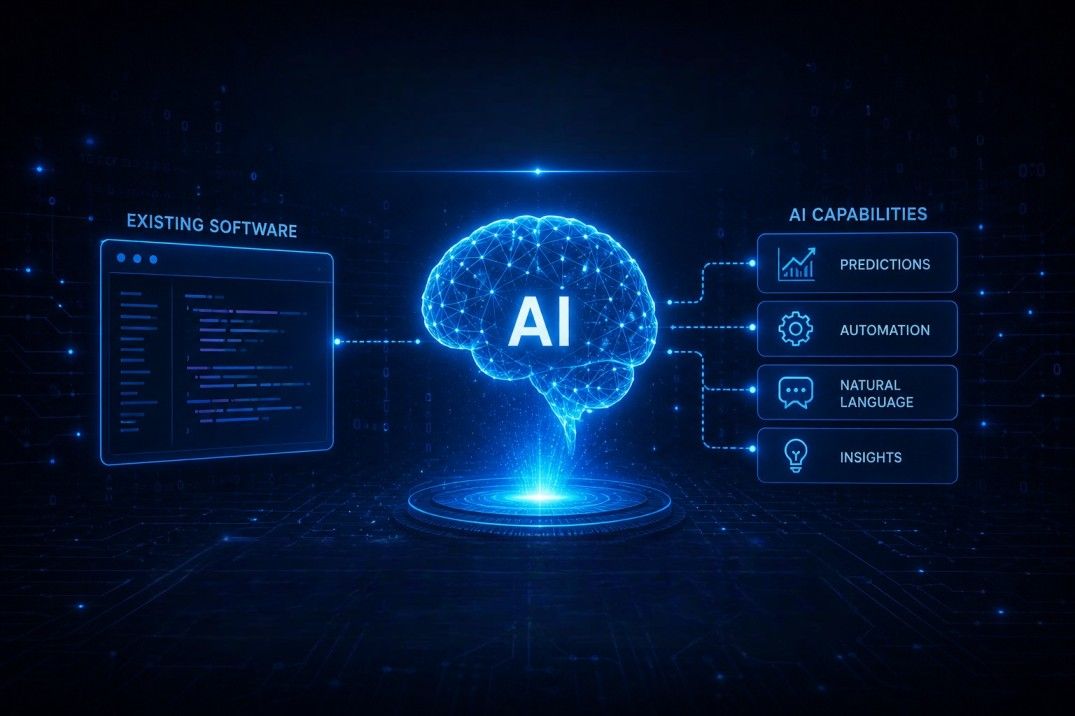
Businesses are no longer building software from scratch every time they need innovation. The smarter approach today is to enhance what already exists. Instead of replacing systems, organizations are embedding AI into their current software to make it more intelligent, responsive, and efficient.
AI integration is the process of adding machine learning models, automation tools, and intelligent algorithms into existing applications. It allows systems to analyze data, predict outcomes, and support real-time decision-making. More importantly, it helps businesses get more value from their current technology investments without disrupting operations.
Phase 1: Assessment and Strategy
Before jumping into implementation, businesses need to understand where AI can make the most impact clearly. This phase is about setting direction and building a strong foundation for the entire journey.
Start by identifying clear and measurable use cases. AI works best in areas where there is a high volume of data or repetitive processes. Instead of broad goals, focus on specific outcomes that can be tracked and improved over time.
- Reducing customer support response time
- Improving demand forecasting accuracy
- Automating repetitive back-office tasks
- Enhancing fraud detection or risk analysis
At the same time, it is important to evaluate the current technology landscape. Existing systems should be checked for compatibility with AI tools. especially their ability to connect through APIs or integration layers. Data readiness is equally critical. AI models depend on clean, structured, and accessible data to perform effectively.
Another key part of this phase is building the right team. AI integration requires a mix of technical and business expertise. Organizations can upskill internal teams, hire specialists, or work with external partners to bridge any gaps.
Phase 2: Planning and Selection
Once the foundation is clear, the next step is to plan how AI will be introduced into the system. This phase focuses on making practical decisions that balance speed, cost, and long-term value. One of the first decisions is whether to build custom AI models or use pre-built solutions. Each approach has its advantages, and the choice depends on business needs.
- Pre-built AI solutions are faster to deploy and more cost-effective
- Custom models offer better control and can be tailored to specific workflows
Most businesses today prefer cloud-based AI services because they are easier to integrate and scale with existing systems.
A phased roadmap is essential at this stage. Instead of trying to implement everything at once, businesses should start with small pilot projects. These projects act as proof of concept and help validate the effectiveness of AI before scaling.
In addition, organizations must establish clear governance and ethical guidelines. AI systems should be designed to handle data responsibly, avoid bias, and maintain transparency.
Phase 3: Integration and Implementation
This is where AI becomes part of the actual system. The focus shifts from planning to execution, ensuring that AI works smoothly with existing software.
The first step is data preparation. Data needs to be cleaned, organized, and converted into standard formats so that AI models can process it effectively. Once the data is ready, integration begins using APIs, ETL processes, or middleware that connects AI capabilities with current applications.
Rather than deploying AI across the entire system, it is best to start with a pilot project or Minimum Viable Product. This allows businesses to test how the system performs in real conditions and make improvements before full deployment.
- Test model accuracy and performance
- Measure system response time and efficiency
- Collect feedback from users and stakeholders
Phase 4: Deployment and Operations
After successful testing, AI can be gradually introduced into daily operations. This phase focuses on ensuring stability, performance, and long-term value.
A phased rollout is the most effective approach. Instead of a full-scale launch, AI features should be introduced step by step. This reduces risk and allows teams to adapt more easily.
Human involvement remains important, especially in critical areas. AI should support decision-making, not replace it completely. In areas like finance, compliance, or customer service, human oversight ensures accuracy and reliability.
To maintain performance, businesses need to continuously monitor AI systems. This is where MLOps plays a key role. It helps track how models perform, detect changes in data patterns, and update models when needed.
- Monitor model performance regularly
- Detect and correct data drift
- Retrain models with new data
Once the system is stable, AI can be expanded to other areas of the business. Continuous improvement ensures that the system evolves with changing needs and delivers long-term value.
What Makes AI Integration Successful
AI integration is not just about technology. It is about how well people, processes, and systems work together.
A few key factors play a major role in success:
- Strong change management: Employees need to understand and adapt to AI-driven workflows
- Modular architecture: API-based systems make integration flexible and scalable
- Right technology partner: Expert guidance helps avoid mistakes and speeds up implementation
When these elements are in place, AI becomes a natural extension of existing systems rather than a complex addition.
Building Smarter Software with Cubet
Embedding AI into existing software is one of the most practical ways to drive innovation. It allows businesses to improve efficiency, gain deeper insights, and stay competitive without rebuilding their systems from scratch.
Cubet approaches AI integration by combining technical expertise with a deep understanding of business needs. Cubet helps organizations add intelligent capabilities to their existing platforms.



Get in touch
Kickstart your project
with a free discovery session
Describe your idea, we explore, advise, and provide a detailed plan.