- Blogs
- /
- Laravel vs Node.js vs Python for Enterprise SaaS: How to Choose the Right Technology Stack
Laravel vs Node.js vs Python for Enterprise SaaS: How to Choose the Right Technology Stack

Choosing a technology stack is not about finding the fastest language. It is about building a product that can scale, evolve, and deliver business value over time.
Every enterprise SaaS product begins with a set of engineering decisions. Some are visible to users, such as the interface and features. Others operate behind the scenes, shaping how the application handles workloads, integrates with other systems, manages data, and adapts to future requirements.
One of the most consequential decisions is the technology stack.
Laravel with PHP, Node.js with TypeScript, and Python with frameworks such as Django or FastAPI are all viable choices for enterprise software. Yet they approach application development differently, offer distinct ecosystem advantages, and suit different technical requirements.
The question is not which technology is universally better. It is which stack aligns with your product's architecture, business workflows, workload characteristics, team capabilities, and long-term operating model.
What Matters When Choosing a Stack for Enterprise SaaS?
Enterprise SaaS applications are rarely limited to simple API endpoints. They often combine complex business rules, role-based permissions, billing systems, reporting dashboards, integrations, background processing, and multi-tenant data management.
As products mature, they may also introduce real-time collaboration, AI-powered features, event-driven workflows, and more demanding data-processing requirements.
A sound technology decision should consider several factors.
Business workflow complexity: How much of the application revolves around CRUD operations, permissions, billing, administrative interfaces, and structured business processes?
Concurrency and workload: Does the product primarily handle conventional web requests, or does it depend on persistent connections, real-time events, streaming, or computationally intensive tasks?
AI and data requirements: Is AI an additional feature, or is machine learning and data science central to the product's core functionality?
Development speed and maintainability: How quickly can the team build, test, deploy, and maintain features without introducing unnecessary architectural complexity?
Team expertise and availability: Does the organisation already have strong PHP, JavaScript/TypeScript, or Python expertise? What skills can it realistically hire and retain?
Operational requirements: How will the application be deployed, monitored, secured, scaled, and maintained as usage grows?
These considerations provide a more useful basis for comparison than language popularity or isolated performance benchmarks.
1. Laravel and PHP: A Structured Foundation for Business-Centric SaaS
Laravel is a mature PHP framework designed to simplify common application-development tasks through a cohesive set of tools and conventions.
Its batteries-included approach provides capabilities such as authentication, database interaction through Eloquent ORM, queues, command-line tooling, and support for background jobs. These features can reduce the amount of infrastructure a team needs to assemble before focusing on product functionality.
Where Laravel fits
Laravel is worth considering when the product revolves around established business workflows, including:
Subscription management and billing.
Role-based access control and permissions.
Administrative dashboards and back-office operations.
Multi-tenant business applications.
Data management, reporting, and workflow automation.
API development and third-party integrations.
Consider an enterprise learning management system. It may need to manage learners, instructors, courses, assessments, subscriptions, permissions, reporting, and administrative workflows.
In such a product, the challenge is not simply processing requests quickly. It is implementing business rules consistently, keeping workflows maintainable, and delivering features efficiently.
Laravel's conventions and integrated ecosystem can be useful in this context.
Laravel and the evolving AI landscape
Laravel is also evolving beyond conventional web application development.
Laravel 13, released on March 17, 2026, introduced a first-party AI SDK with capabilities for text generation, tool-calling agents, embeddings, audio, image generation, and vector-store integrations. These capabilities make it possible to integrate AI-powered functionality within the Laravel ecosystem. Official Laravel release notes
For SaaS products adding intelligent search, AI assistants, or workflow automation, this development expands the options available to Laravel teams. The suitability of a particular implementation will still depend on the AI provider, workload, data requirements, and deployment architecture.
Performance and trade-offs
Traditional PHP request handling and long-running worker models have different performance characteristics. Laravel Octane, for example, supports application execution through long-lived workers, which can improve throughput for suitable workloads.
However, introducing persistent workers changes the runtime model. Developers must account for application state, resource lifecycle, and worker behaviour. Octane also does not automatically make Laravel equivalent to an asynchronous, event-loop-driven runtime.
Laravel's conventions can reduce architectural decision-making, but that does not make it the right choice for every workload.
Consider Laravel when: business workflows, structured application development, maintainability, and rapid delivery are central priorities.
2. Node.js and TypeScript: Built for I/O-Intensive and Real-Time Applications
Node.js takes a different approach to server-side application development. Its event-driven architecture and non-blocking I/O model make it particularly relevant to applications that handle many concurrent operations involving networks, databases, and external services.
TypeScript adds static typing to the JavaScript ecosystem, helping teams structure larger applications and identify certain errors during development.
Together, Node.js and TypeScript form a flexible foundation for modern backend systems.
Where Node.js fits
Node.js is worth evaluating when an application depends heavily on:
Real-time dashboards and live data updates.
Chat and messaging systems.
Collaborative editing and shared workspaces.
Streaming APIs and persistent connections.
Event consumers and integration-heavy services.
High volumes of concurrent I/O operations.
Imagine a retail analytics platform that receives inventory updates from multiple locations, processes events from external systems, and refreshes dashboards as new information arrives.
A Node.js service can be a suitable choice for handling these concurrent, I/O-intensive interactions.
The same applies to collaboration tools where maintaining connections and responding to events are core parts of the user experience.
The flexibility of the Node.js ecosystem
Node.js offers several framework options, including Express, Fastify, and NestJS.
This flexibility allows engineering teams to choose an architecture that matches their requirements. TypeScript can also help establish clearer contracts across services and improve the maintainability of large codebases.
However, flexibility comes with responsibility.
Teams need to make decisions about project structure, validation, authentication, dependency management, error handling, and architectural conventions. Frameworks such as NestJS provide more structure, while lighter alternatives leave more choices to the engineering team.
Node.js's event loop also requires careful consideration. CPU-intensive operations can block the event loop if they are not appropriately isolated or offloaded.
Consider Node.js and TypeScript when: real-time interactions, concurrent I/O, event-driven workflows, or existing JavaScript/TypeScript expertise are important to the product.
3. Python: A Strong Choice for AI, Machine Learning, and Data-Driven Products
Python occupies an important position in enterprise development, particularly where application logic intersects with machine learning, analytics, and data science.
Its ecosystem provides tools for data processing, model development, experimentation, and integration with AI services. This makes Python especially relevant when intelligence is not simply an add-on but a central part of the product.
Python web development offers different approaches depending on the application.
Django provides an integrated framework with features such as an ORM, authentication, and an administrative interface. FastAPI offers a more API-focused approach, with support for asynchronous endpoints and type-annotation-based request validation.
Where Python fits
Python is worth considering for products involving:
Machine learning and predictive analytics.
Recommendation engines and personalisation.
Data-intensive applications.
AI-assisted decision-making.
Intelligent document processing.
Model inference and data-science workflows.
Consider a healthcare platform that analyses historical data to support risk prediction or a learning platform that uses learner interactions to inform personalised recommendations.
Python can provide a natural environment for implementing the underlying data and machine-learning logic.
If the product also requires extensive user management, billing, permissions, and administrative workflows, Django may offer a useful integrated foundation.
For API-focused services, FastAPI may be more appropriate, depending on the system's architecture and requirements.
Understanding Python's concurrency model
Python's concurrency story requires more nuance than simply describing it as slow or fast.
For I/O-bound applications, asynchronous programming can help manage many concurrent operations while waiting for external services or databases.
CPU-bound workloads present a different challenge. Their performance depends on the execution model, available libraries, hardware, and deployment architecture.
Python 3.14 also established official supported status for free-threaded builds under PEP 779. These builds can allow threads to execute Python code in parallel without the traditional Global Interpreter Lock in the relevant configuration. However, compatibility with third-party extensions, memory overhead, and workload characteristics still matter. Free-threading does not automatically make every Python application faster. Python's free-threading documentation
Consider Python when: machine learning, data processing, or AI-related functionality is closely tied to the product's core domain, or when the existing team has strong Python expertise.
Laravel vs Node.js vs Python: A Practical Comparison
The differences become clearer when the technologies are evaluated against common enterprise requirements.
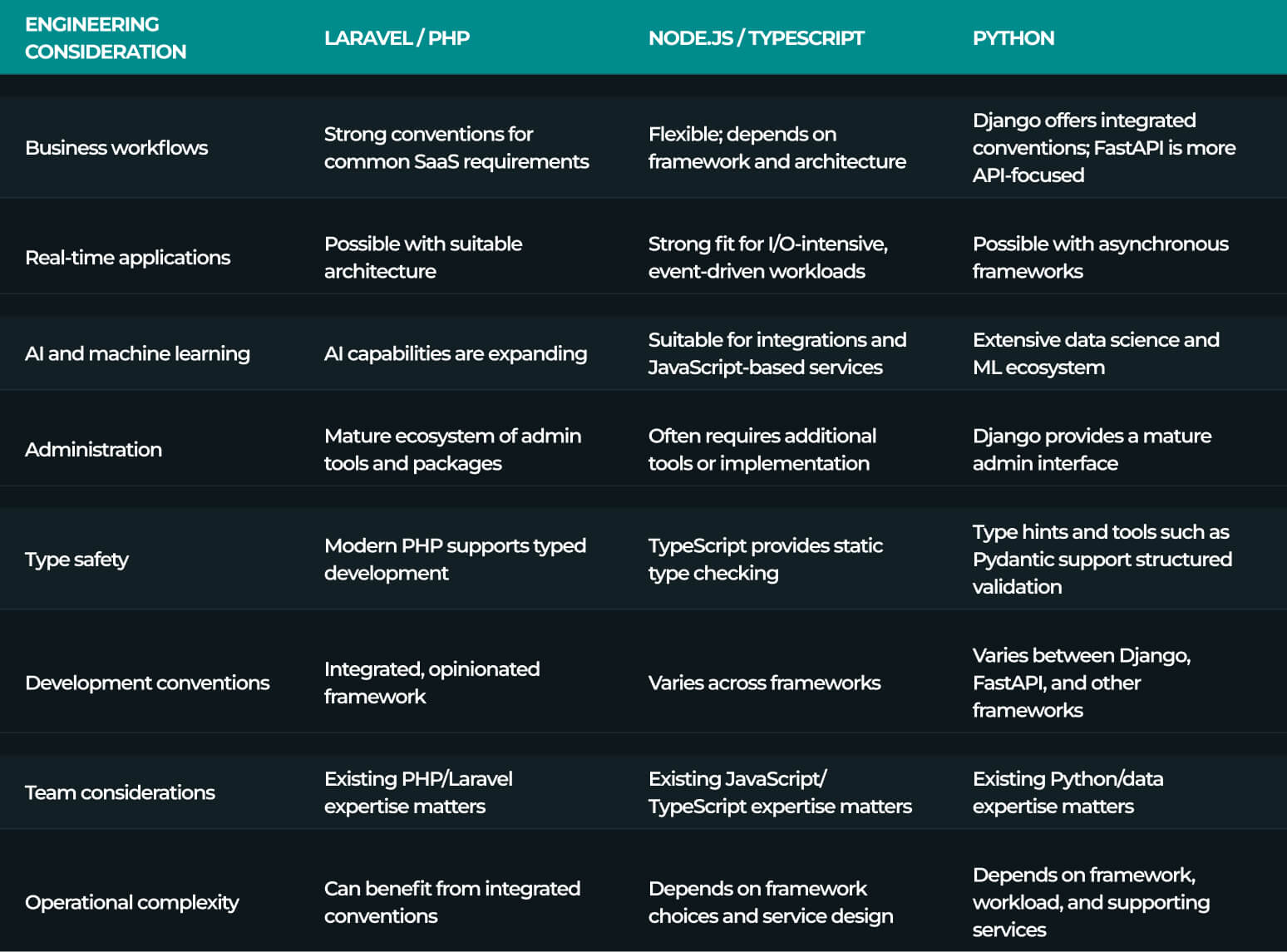
This comparison is a starting point rather than a ranking. Each stack can support a broad range of applications, and the eventual outcome depends on how the application is designed and operated.
4. Performance and Concurrency: What Should Enterprises Actually Measure?
Performance comparisons are often reduced to a single question: Which language is fastest?
For enterprise SaaS, that question is incomplete.
An application may spend most of its time waiting for database queries, communicating with external APIs, processing messages, or running business logic. The language alone does not determine the overall response time or system capacity.
A meaningful evaluation should examine the actual workload.
Request-response workloads
For conventional APIs and business applications, database query efficiency, caching, network latency, and application design can have a substantial influence on performance.
A well-structured Laravel application may outperform a poorly designed service written in another stack. The reverse can also be true.
High-concurrency workloads
Applications with many concurrent network operations may benefit from Node.js's event-driven, non-blocking I/O model.
However, the complete architecture matters, including connection management, database capacity, backpressure, and the way CPU-intensive work is handled.
CPU-intensive workloads
Data processing, model inference, and computationally expensive tasks require different evaluation criteria.
Python may offer direct access to specialised libraries and optimised numerical operations, while other stacks may be better suited to different computational architectures.
The important distinction is between the performance of the language runtime and the performance of the complete system.
What should be benchmarked?
Before selecting or replacing a stack, measure:
Response times under realistic traffic.
Throughput and concurrent workload capacity.
Database performance and connection usage.
CPU and memory consumption.
Queue processing and background-job latency.
Infrastructure costs at expected traffic levels.
Behaviour under failure, traffic spikes, and sustained load.
Benchmarks should use comparable workloads, deployment conditions, and configurations. Results from unrelated language or framework comparisons cannot reliably establish which of these three options will perform best for a specific product.
5. Team Expertise, Ecosystem, and Long-Term Cost
Technology decisions are also organisational decisions.
A stack that fits the technical requirements may still create difficulties if the organisation lacks the skills to develop, maintain, and operate it.
Existing expertise can influence delivery speed, onboarding, code quality, and the cost of introducing new capabilities. Local hiring availability also matters, but it varies by region and should be evaluated using actual market evidence rather than broad assumptions about developer costs.
Ecosystem maturity deserves similar attention.
A framework with established authentication, testing, database, and administrative tools may reduce the amount of custom engineering required. A flexible ecosystem may provide more specialised options, but it can also introduce additional integration and maintenance work.
Long-term cost should therefore include more than the initial development budget. It should account for:
Ongoing feature development.
Infrastructure and deployment.
Monitoring and incident response.
Security updates and dependency maintenance.
Hiring, onboarding, and knowledge transfer.
Future migrations and architectural changes.
The right choice is the one that supports the organisation's delivery goals without creating avoidable long-term complexity.
6. Practical Scenarios: Matching the Stack to the Product
Rather than ranking technologies in isolation, consider how they fit different enterprise situations.
Scenario 1: A workflow-heavy enterprise SaaS platform
A product manages customers, permissions, subscriptions, billing, reporting, and administrative workflows.
Engineering consideration: Laravel may be a strong candidate because its integrated conventions and ecosystem support common business application requirements. Django is another option where its integrated features align with the product. Node.js can also work well with an appropriate framework and architecture.
The decision should account for the team's existing skills and the complexity of the business domain.
Scenario 2: A real-time collaboration platform
A product requires live dashboards, shared workspaces, event notifications, and persistent client connections.
Engineering consideration: Node.js and TypeScript deserve close evaluation because their event-driven, non-blocking I/O model aligns with many such workloads.
The team must still design for event delivery, connection management, failure recovery, and any CPU-intensive processing.
Scenario 3: An AI-driven product
A SaaS application relies on predictive models, recommendations, document processing, or data-science workflows.
Engineering consideration: Python may be a natural fit when model development and data processing are central to the product. Laravel and Node.js remain viable options for the application layer, particularly when AI capabilities are consumed through APIs or integrated services.
Scenario 4: A mature Laravel application
An established product already has a stable Laravel architecture, a capable PHP team, and business workflows that fit the framework.
Engineering consideration: Continuing with Laravel may be more practical than introducing a new stack without a clear technical reason.
A migration should solve a defined problem, such as a workload limitation, a capability gap, or an architectural constraint. Rewriting a working system solely to adopt a different language can introduce substantial cost and risk.
Scenario 5: A SaaS product with a separate machine-learning service
A product needs conventional business workflows alongside specialised machine-learning capabilities.
Engineering consideration: A combination such as Laravel for the core application and Python for ML services may be appropriate if the separation provides a genuine architectural benefit.
The services can communicate through well-defined APIs or messaging systems, allowing each component to use the tools that best fit its responsibilities.
7. When Does a Hybrid Architecture Make Sense?
Enterprise products do not always need to rely on a single technology stack.
A hybrid architecture can be useful when different components have genuinely different requirements.
For example, a system could use:
Laravel for core business workflows, permissions, billing, and administration.
Node.js for real-time connections or event-driven services.
Python for machine-learning pipelines, inference, or data-science operations.
This arrangement allows each service to address a specific technical requirement.
However, adding technologies is not the same as improving architecture.
Every additional stack introduces responsibilities around deployment, observability, security, dependency management, hiring, testing, and maintenance. Teams must also manage service contracts, network failures, data consistency, and cross-service debugging.
A hybrid architecture is justified when the benefits of separation outweigh these costs.
Before introducing another stack, ask three questions:
Is there a clearly defined workload or domain requirement that the existing stack cannot address as effectively?
Will separating the service improve scalability, maintainability, team ownership, or access to specialised capabilities?
Does the organisation have the operational maturity to support the additional technology?
If the answers are unclear, a simpler architecture may be the more sustainable choice.
Conclusion: Choose for the Product You Need to Build
Laravel, Node.js, and Python offer different strengths for enterprise SaaS development. Their value depends on the product's requirements, not on a universal ranking of languages.
Laravel is worth considering for structured, workflow-heavy applications. Node.js and TypeScript are strong candidates for I/O-intensive and real-time systems. Python is particularly relevant when machine learning and data science are central to the product.
There is also no requirement to choose one stack for every component. A hybrid approach can be effective when the architecture reflects genuine differences in workload or domain requirements.
The more important decision is to understand what the product needs today, how those requirements may evolve, and what the organisation can sustainably build and operate.
The right technology stack is not the one with the most impressive feature list. It is the one that supports the right architecture, enables reliable delivery, and remains maintainable as the business grows.

Sujith K
Project Manager


Related Blogs



Get in touch
Kickstart your project
with a free discovery session
Describe your idea, we explore, advise, and provide a detailed plan.