Continuum: Cubet's Framework for Modernizing Legacy Laravel Applications
Legacy rarely arrives as a crisis. It usually starts with a Laravel upgrade that gets pushed for a more urgent release, a dependency that quietly becomes hard to maintain, test coverage that never gets built, or a developer who leaves and takes undocumented context with them. The application still works. It just gets harder to change.
A few years later, the real question isn't "should we upgrade Laravel?" It's "how do we modernize this application without disrupting the business logic, data, customers, data, and operations it has supported for years?"
This is the situation many enterprise Laravel applications are in today. It's also exactly the problem Continuum, Cubet's structured Laravel modernization framework, is built to solve.
What is Laravel modernization?
Laravel modernization is the process of bringing a legacy Laravel application, one running on an outdated, often unsupported framework or PHP version, up to a current, secure, and maintainable state, without rewriting the application from scratch. It typically involves a sequential series of version upgrades ("hops"), remediation of breaking changes and abandoned dependencies, rebuilding test coverage, and validating that the application behaves identically before and after the change.
Unlike a new build, modernization has to preserve years of accumulated business logic, data, and integrations while the underlying framework changes beneath it, which is what makes it a fundamentally different (and riskier) kind of project than greenfield development.
Why is Laravel modernization becoming a business priority?
Laravel has defined security support windows for its major releases. Once a version reaches the end of its security support period, organizations can no longer rely on the framework receiving security fixes for newly discovered vulnerabilities. Running behind a firewall can reduce exposure, but it does not eliminate the underlying vulnerability.
That single fact drives most of the downstream risk:
Security and compliance exposure. An unsupported Laravel version is a direct audit finding under frameworks like HIPAA, PCI DSS, and BFSI regulations, the kind of gap a security audit surfaces early, and it's increasingly a standard due-diligence question in enterprise procurement.
Non-linear cost growth. Laravel modernization is typically approached through sequential version upgrades, which means an application of several major versions behind can require multiple upgrade hops before reaching a current supported release. The longer modernization is deferred, the more likely it is that dependencies, PHP versions, framework changes, and accumulated technical debt will increase the scope and complexity of the work.
A ceiling on AI-assisted development. Legacy codebases can also limit the value organizations get from AI-assisted development. Fat controllers, missing type hints, limited test coverage, undocumented business logic, and tightly coupled components make it harder for AI tools to safely understand and modify existing applications, the same architectural blockers AI-ready architecture work is built to clear.
Declining feature velocity. The same patterns that make an application risky to touch, no tests, N+1 queries, no CI/CD, are the direct cause of slower releases, more production incidents, and the "we can't move as fast as we used to" conversations engineering leaders have with the business.
A hard performance ceiling. Traditional PHP-FPM deployments bootstrap the entire framework on every request. Modern Laravel deployments using technologies such as Octane can provide significant performance improvements for suitable workloads, but realizing those benefits requires an application architecture that can safely support the underlying execution model.
Expensive integrations. A modern Laravel application with a clean API layer can integrate a new payment provider or CRM in hours. The same task on a legacy codebase, with no standardized API layer, can take weeks, and new third-party packages increasingly only support recent Laravel versions at all.
A talent problem that compounds itself. Laravel has a large and active developer ecosystem, but attracting and retaining engineers can become more difficult when an application relies on outdated framework versions, legacy patterns, limited test coverage, and undocumented business logic.
None of these risks resolve themselves. They compound every quarter a modernization decision is deferred.
Why "just upgrade it" isn't a strategy?
For an application one version behind, treating a Laravel upgrade as a scoped sprint task, run composer update, fix what breaks, can work. For an application several versions and several years behind, it almost never does. The real risk isn't the version bump; it's everything around it: business logic no one currently understands well enough to refactor safely, abandoned packages with no drop-in replacement, and a production environment that can't tolerate an extended outage while the work happens. Unstructured attempts are how modernization projects run over budget, break production, or get abandoned halfway through in a worse state than they started. That's the gap a repeatable methodology is meant to close.
The alternative isn't always a rewrite
For an application with years of accumulated business value, "modernize the old thing" often has to compete internally against "just rebuild it properly, on something current." That instinct is understandable, but it's rarely the cheaper or safer option. A full framework migration means reconstructing not just the code but the institutional knowledge, integrations, and edge-case handling the current application already encodes, from scratch, in an unfamiliar stack, usually at several times the cost and risk of an in-place modernization.
As Laravel's first APAC Partner, Cubet has a deep understanding of the Laravel ecosystem and a strong interest in helping organizations continue to get value from the applications they have already built. An application kept on Laravel, brought up to a current, secure, AI-ready state, is both the lower-risk outcome for the business and a healthier outcome for the ecosystem than one more application quietly migrating away because nobody built a structured path to keep it. Continuum's default posture is to extend the life of Laravel applications, not replace them, checked against the same Decision Framework's rewrite test covered below, so that posture is a reasoned call for each application, not an assumption.
That's the case for staying in Laravel. The rest of this post explains how Continuum approaches Laravel modernization in practice.
Introducing Continuum
Continuum is Cubet's structured framework for taking a Laravel application from legacy risk to long-term maintainability. It replaces the open-ended "let's discuss your Laravel upgrade" conversation with a named, six-stage methodology, each stage producing a specific, signed-off deliverable rather than a status update.
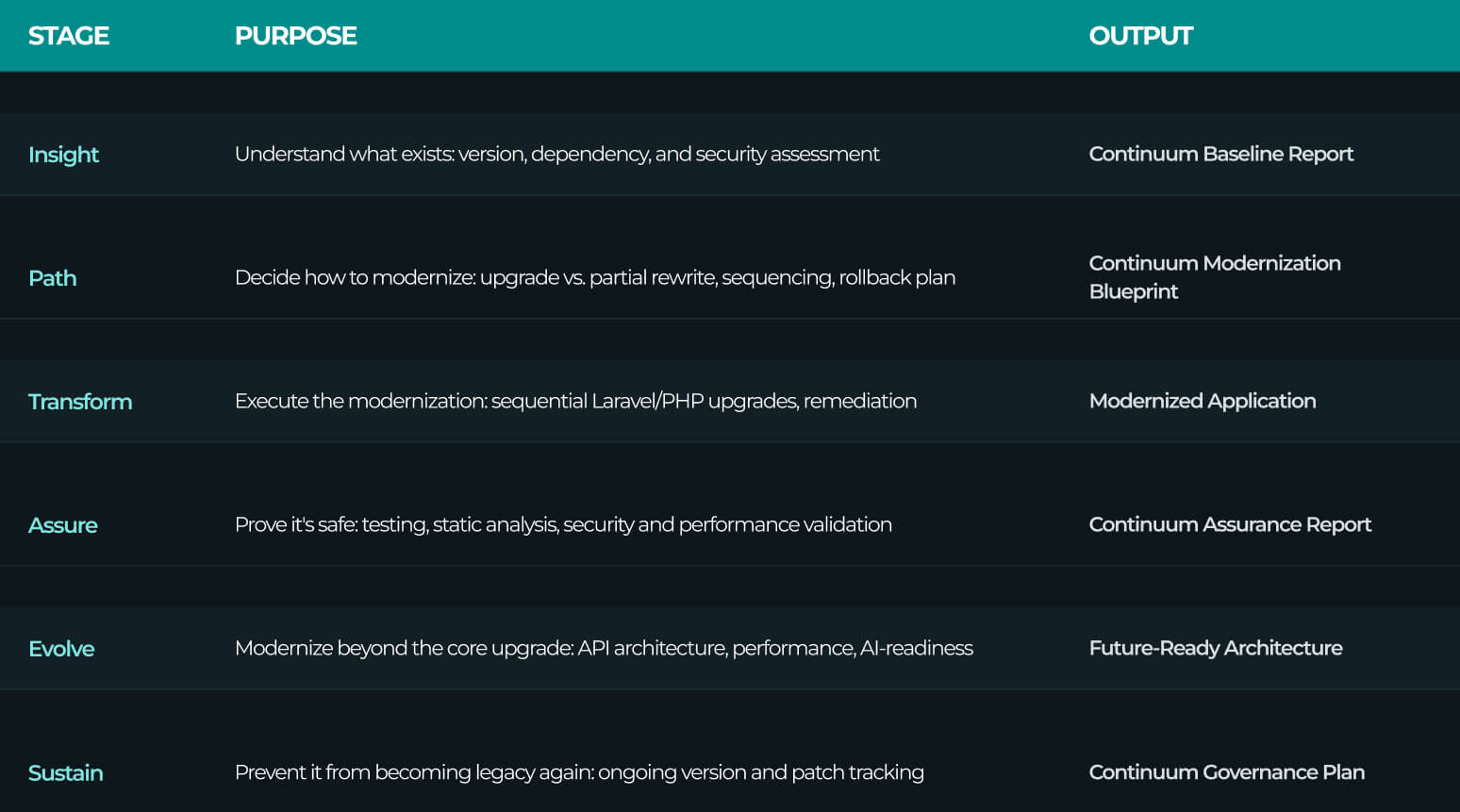
These six stages translate into a simple commercial structure rather than six separate purchase decisions. Insight stands alone as a fixed-price assessment. Path, Transform, and Assure form the core modernization phase, taking the application from planning through implementation and validation. Evolve and Care are optional, allowing organizations to extend modernization into architecture, performance, AI-readiness, and ongoing maintenance.
Two things distinguish this from a generic upgrade engagement. First, every stage produces something concrete a client can review and sign off on, there's no point in the engagement where progress is a black box. Second, the framework treats the core modernization as sequential and non-skippable, in the same way Laravel itself does: an application on Laravel 6 or earlier moves through Insight and Path before a single line of code changes, precisely because skipping that analysis is where legacy modernization projects usually go wrong.
How does Continuum protect uptime and data?
The two failure modes technical teams worry about most in a legacy migration are downtime and data loss. Continuum addresses both directly rather than as an afterthought:
Upgrades happen in a parallel environment: nothing is modernized in the live production path.
Cutover uses a blue-green deployment: traffic shifts to the modernized environment only after full validation, with instant reversion available if anything fails.
High-risk changes ship behind feature flags, enabled gradually rather than all at once.
Every hop takes a full schema and data snapshot beforehand, with dual-write verification on schema-changing migrations before the old path is retired.
Automated reconciliation reports compare row counts and checksums before and after every migration.
The Continuum Score: Measuring Laravel Modernization Readiness
A recurring problem with legacy-system audits is that they produce a narrative report, pages of prose that are hard to compare, track, or act on. Continuum's Insight stage instead produces a Continuum Score: a six-dimensional assessment of an application's modernization readiness, measured directly from the codebase, dependency manifest, CI/CD configuration, and security scan results , not a self-reported questionnaire.
The six dimensions:
Framework Currency — current Laravel and PHP version against the latest supported release
Dependency Health — the proportion of Composer packages that are actively maintained versus abandoned or incompatible
Security Exposure — unresolved CVEs, weighted by severity
Code Quality — static analysis level achieved (PHPStan) plus automated test coverage
Architecture Readiness — presence of a clean API layer, query patterns, and readiness for tools like Octane or Vapor
Operational Resilience — CI/CD maturity, monitoring, and rollback capability
Each dimension is scored out of 10 at Insight and re-measured at Assure, so the improvement is demonstrable rather than asserted. The same score also gives engineering leadership a simple way to communicate modernization progress to non-technical stakeholders; a single number moving from "critical" toward "optimized" is a much easier story to tell a board than a changelog.
The Continuum Decision Framework™
Not every organization engages a partner for modernization work, and Continuum's second major component reflects that. The Continuum Decision Framework is a standalone methodology for deciding how to approach a legacy Laravel modernization, useful whether or not Cubet is the one doing the work.
It covers four decisions every technical leader has to make before starting:
Establish your starting position. The starting Laravel version is one of the first signals of modernization scope. An application only one major version behind may require a relatively contained upgrade, while an application several major versions behind can require multiple upgrade hops, PHP changes, dependency remediation, and significantly more testing.
A Laravel 12 application is roughly a one-day, one-hop upgrade; a Laravel 7 application, six or more hops plus a PHP upgrade, is a multi-week program.
Upgrade in place, or partial rewrite? A five-point test (does the codebase reflect business logic no one runs anymore? Is more than half the custom logic undocumented? Is a compliance requirement forcing a new architecture regardless?) determines the path. As a rule of thumb: upgrade in place when the business logic is proven and the architecture is still fundamentally viable — the right default for most applications. Consider a partial, strangler-fig-style rewrite when major parts of the application are no longer relevant, or the existing architecture can't support what the business needs next.
Define risk tolerance. What downtime budget is actually acceptable? Which data cannot tolerate even a brief reconciliation window? Which compliance gates are non-negotiable before go-live versus after?
Set success criteria before work begins. Target version, minimum test coverage, a clean security scan, a defined performance benchmark, and named business-stakeholder sign-off, agreed in writing during Discovery, not asserted afterward.
How Continuum is delivered?
Continuum resolves into four commercial products, each mapped directly to the framework above, so an organization is never asked to commit to more than the next decision actually requires:
Continuum Discovery (Insight) — a fixed-price, standalone assessment. Delivers the Baseline Report and the Continuum Score, plus a high-level roadmap and cost estimate for the modernization itself. There's no obligation to continue , Discovery is designed to be useful on its own, even if the organization decides to modernize later, or with a different partner.
Continuum Transform (Path + Transform + Assure) — the core modernization, delivered as one bundled phase rather than three separately billed stages. It opens with detailed planning (the Continuum Modernization Blueprint, the sequenced hop plan and rollback strategy), moves through the upgrade work itself, and closes with the validation (the Continuum Assurance Report) that proves it's safe to go live. Priced as a single phase from the Discovery estimate, with a staged cutover into production.
Continuum Evolve (optional) — for organizations that want to go beyond the core upgrade: performance work, API and architecture modernization, data modernization, and AI-readiness. This is a deliberate next step for teams ready to turn a modernized application into a genuinely modern one, not something bundled into the base engagement by default.
Continuum Care (optional) — an ongoing maintenance plan, structured similarly to an annual maintenance contract: version-currency tracking, dependency monitoring, and quarterly reviews, so the application doesn't quietly drift back into legacy status a few years after go-live.
Pricing is fixed per phase rather than open-ended time and materials, and any scope discovered outside the signed plan goes through written change control before work begins on it, the two things that most commonly turn modernization projects into budget and trust problems.
Common questions about Laravel modernization
Are Evolve and Care part of every Continuum engagement?
No. Only Discovery and the bundled Transform phase are part of a core modernization. Evolve and Sustain are optional and priced separately, and neither depends on the other, an organization can take Care without Evolve, Evolve without Care, both, or neither.
Isn't it better to just rewrite the application on a newer stack?
Not necessarily. A full rewrite can be the right choice when the existing architecture, business logic, or product direction no longer supports the organization's needs. But for many legacy Laravel applications, modernization can preserve valuable business logic, integrations, data, and institutional knowledge while reducing technical and operational risk.
Do I need to modernize now, or can it wait another year?
Waiting is rarely free. Because Laravel doesn't allow skipping versions, every deferred year can add another mandatory upgrade hop, and dependencies that work today are more likely to be abandoned by the time the upgrade eventually happens. A Discovery-style assessment can quantify the actual cost of waiting for a specific application rather than relying on a general rule of thumb.
What Laravel version should I target?
The right target depends on the application's current Laravel and PHP versions, dependency compatibility, business requirements, and risk tolerance. In general, the objective should be to reach a current, supported Laravel release with an appropriate security window, rather than simply targeting the newest release available.
Can we keep shipping features during a modernization project?
Yes, if the upgrade work happens in a parallel environment rather than the live production codebase. Under that model, a feature freeze is typically only needed for the short final cutover window, not the length of the engagement.
How is Laravel modernization different from general PHP application modernization?
Laravel provides a defined upgrade path, established ecosystem tooling, and a strong set of modernization practices that can make sequential upgrades more tractable. But those tools do not eliminate the need to understand business logic, dependencies, testing, data, and operational risk at every stage.
What's the biggest risk in a legacy Laravel modernization?
Undocumented business logic. The technical mechanics of a version upgrade are well understood; the risk is refactoring or replacing code without correctly understanding what it's currently doing for the business, which is why a structured discovery phase, not just a code diff, is the foundation of a safe modernization.
Where to start with Laravel modernization?
The application doesn't have to be rewritten, and the decision doesn't have to be made blind. A structured Laravel modernization assessment, what Continuum calls Discovery, turns "we probably need to modernize at some point" into a specific, costed roadmap for the application in question, with no commitment beyond that first step.
If a Laravel application on your team's roster has lost security support, accumulated significant technical debt, or has reached a point where nobody currently understands its custom business logic well enough to change it safely, that's a signal to assess the application now, before the modernization effort becomes larger, riskier, and more disruptive.
Continuum is Cubet’s structured program for Laravel modernization and legacy application modernization. Read the Continuum Decision Framework for a deeper walkthrough of how to evaluate your own starting position or get in touch to scope a Continuum Discovery engagement.
Mathews Abraham
VP - Revenue & Growth





Get in touch
Kickstart your project
with a free discovery session
Describe your idea, we explore, advise, and provide a detailed plan.