
Why the way we approach a problem matters as much as the technology we use to solve it.
The biggest risk for businesses adopting artificial intelligence may not be choosing the wrong technology. It may be applying new technology without reconsidering the assumptions, processes and decisions that shaped the original problem.
There is a more fundamental question worth asking: Are we using new technology to improve the way we have always worked, or are we rethinking how we approach problems altogether?
For decades, conventional engineering practices have helped businesses build complex systems and scale their operations. Requirements analysis, established methodologies, technical expertise and disciplined execution remain essential. But the challenges businesses face are changing, and so are the tools available to address them.
Cubet works across software engineering, data and AI has increasingly brought this question into focus. It has shaped how we think about the role of technology and led us to bring three interconnected principles under one approach: AI³ — Intelligence, Innovation and Impact.
The superscript three represents these three dimensions. Together, they describe how we approach problems, make engineering decisions and measure the value of what we build. AI³ is not simply about adopting artificial intelligence; it is about bringing intelligence into how we think, innovation into how we solve problems and impact into how we define success.
From Conventional Engineering to a Broader Way of Thinking
Traditional engineering often begins with what is known: defined requirements, established processes and proven technical approaches. This provides structure, reduces uncertainty and helps teams deliver consistently.
Good engineering depends on experience and discipline, and AI³ builds on both. What it adds is a wider set of questions to ask before deciding what to build.
What is the underlying business problem? Are the existing assumptions still valid? Is there a better way to approach the requirements? How will we know whether the solution has made a difference?
The distinction becomes clearer when we look at how the two approaches can influence everyday engineering decisions.
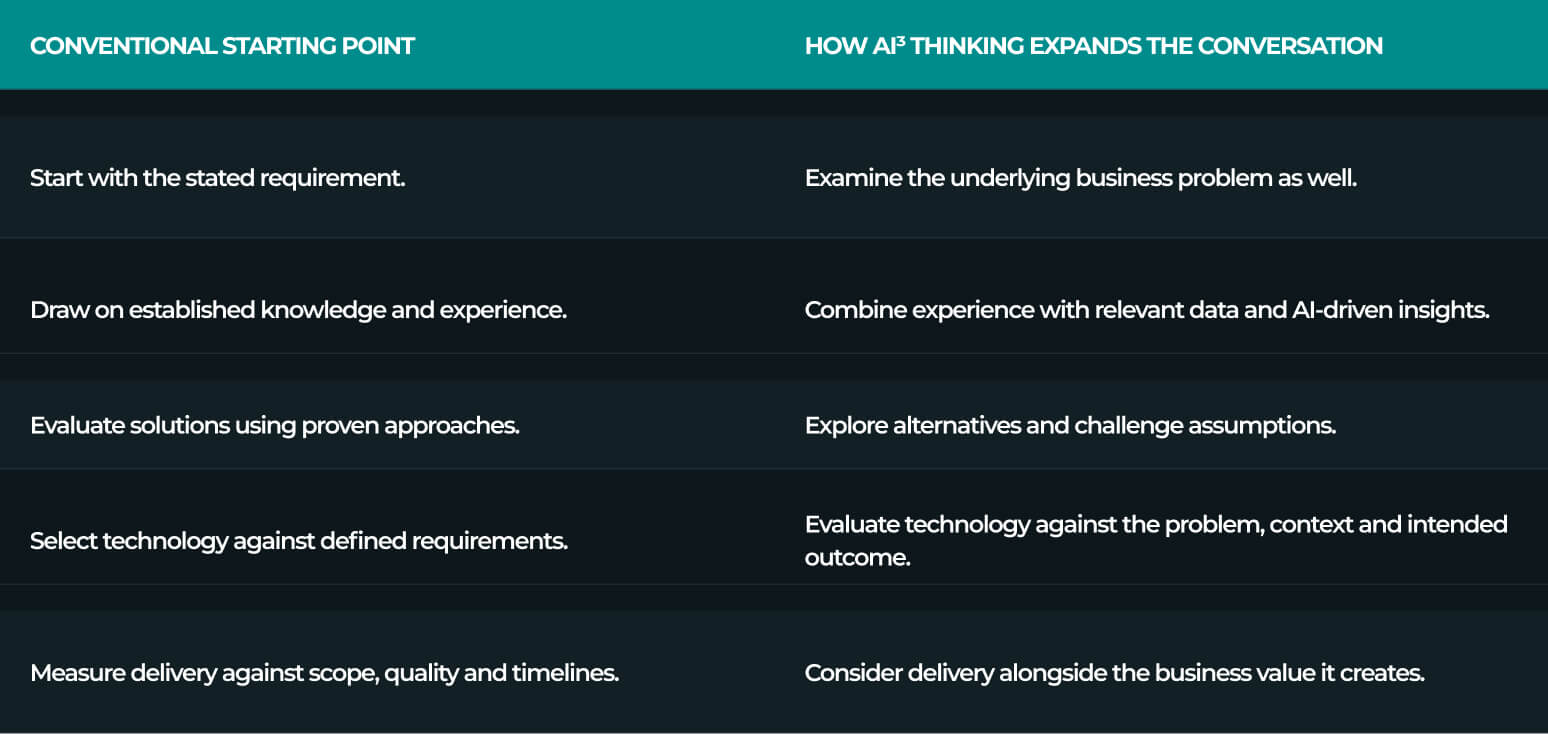
Both approaches share the same engineering foundation. AI³ widens the perspective we bring to a challenge and the criteria we use to judge a solution.
Intelligence: Understand Before You Build
A technology solution is only as good as the understanding behind it. A business requirement rarely tells the whole story. Existing systems, dependencies, operational constraints and hidden problems all need to be considered before deciding on an approach.
Cubet see Intelligence as bringing together engineering expertise, business context, data and AI to make better-informed decisions. AI helps us work through large volumes of information and spot patterns faster. Those findings become useful only when they are interpreted against the business and its technical environment.
Sometimes the right answer doesn't involve AI at all. A well-designed application, a cleaner integration or a simple automation may serve the problem better. Understanding the problem properly is what makes that call possible.
Innovation: Question What Already Exists
New models, frameworks and development approaches are arriving faster than most teams can evaluate them. Many open up ways of solving problems that were impractical a few years ago, which makes experimentation important for any engineering team.
Our dedicated AI³ R&D centre gives this exploration a focused space, where we research emerging technologies, evaluate new approaches and test their practical applications.
Cubet explores emerging technologies, evaluates different models, experiments with LLM-based applications, and examines how agentic workflows can address practical business requirements. Experimentation is the starting point. The real work lies in understanding what a new approach offers, where it falls short, and whether it creates an advantage over what already exists.
For us, Innovation means recognising where a different approach can make a real difference, then having the engineering discipline to turn that idea into a working solution. The goal is a better way of doing something that matters.
Impact: Look Beyond What Gets Delivered
Technology delivery is often measured through completed features, project milestones, timelines, and technical specifications. These measures are necessary, but they don't always tell us whether a solution has achieved what the business originally intended.
A platform can be delivered successfully without improving the process it was designed to support. An automated workflow can reduce manual effort but introduce new operational challenges. A product can gain more features without becoming more useful to its users.
This is why Impact needs to be part of engineering conversation from the beginning. We look beyond technical completion to consider whether a solution addresses the original problem, improves the way people work and creates measurable business value. Reliability, scalability, security and maintainability matter too, because they determine whether that value lasts.
Delivering on time and to scope is the baseline. What the delivery achieves for the business is the real test.
Seeing AI³ in Practice: An EdTech Engagement
A Learning platform approached us to implement AI-powered workflow automation.
Before building anything, we looked at where automation would actually make a difference: which processes took the most manual effort, where delays affected learners or staff, and what the platform needed the investment to achieve.
We then designed and built the automated workflows. We didn't treat go-live as the finish line, though. After deployment, we continued to monitor how the workflows performed in day-to-day operations and refined them where they weren't yet meeting the platform's needs.
Working software was the starting point. We evaluated success against the return the platform expected from its investment, rather than treating implementation as the end result.
For us, this captures the distinction AI³ is built on: implementing an AI system is one achievement; making it deliver business value is another.
What This Looks Like When You Work With Us
AI³ should be visible in how we work with clients. In practice, that means:
Understanding before recommending: We examine the business problem, its context and the outcome the organisation wants to achieve before recommending a technology approach.
Looking at the bigger picture: We consider existing systems, data, workflows and operational constraints to understand where AI and other technologies can fit.
Testing before committing: We evaluate emerging technologies and practical alternatives, and validate their suitability before adopting them.
Staying accountable to outcomes: We look beyond implementation milestones and work towards the business value the solution is expected to deliver.
AI³: A Direction for the Future
AI³ places a responsibility on us to keep learning, question our own assumptions and stay open to different ways of solving problems. Technology will keep changing, and our approach has to change with it.
AI³ is a long-term direction for how we think and engineer, and we expect it to outlast any single technology trend.
The advantage will not come simply from having access to more tools or adopting them faster. It will come from knowing which problems are worth solving, which approaches are worth pursuing, and what good outcomes should look like.
Intelligence. Innovation. Impact. That's AI³.
The real advantage is not simply in adopting technology faster, but in knowing where to apply it, how to make it work and what it should achieve.

Mathews Abraham
VP - Revenue & Growth


Related Blogs



Get in touch
Kickstart your project
with a free discovery session
Describe your idea, we explore, advise, and provide a detailed plan.