The MERIT Framework: Diagnosing AI Before Engineering Begins.

#Cubetredifined #TheMeritFramework
The majority of AI initiatives fail before engineering becomes the problem.
Not because the models are weak. Not because the technology is immature. But because organisations commit to implementation before validating where AI creates measurable business value.
Today, most enterprises already have AI activity underway. Teams are experimenting with copilots. Departments are testing automation workflows. Vendors are pitching platforms. Internal demos exist. Budgets are being discussed.
The problem is not a shortage of AI ideas.
Enterprises are increasingly moving into implementation before identifying where AI creates operational leverage. And that is where most AI investments quietly lose momentum.
The Real Problem Is Not AI Adoption. It Is AI Prioritisation.
Across industries, leadership teams are under pressure to "do something with AI." The result is predictable: disconnected pilots, department-level experimentation, technology-first discussions, and undefined ROI expectations. AI becomes a collection of experiments rather than a structured business transformation initiative.
The issue is rarely technical capability. Modern AI tooling has already lowered the barrier to building. What organisations struggle with is deciding which workflows actually justify AI investment, which initiatives are operationally feasible, where measurable ROI exists — and equally important, what should not be built.
Without this decision layer, engineering begins too early. And engineering without clarity is expensive.
Where Enterprises Typically Start
Most AI consulting engagements begin in one of three situations.
Situation 01 — You know what to build, but not what to prioritise. Multiple AI opportunities exist across the organisation, but there is no structured basis for deciding where investment should begin. Every function believes its use case matters most. Leadership sees potential, but prioritisation becomes subjective.
Situation 02 — Leadership needs structure before committing. Interest in AI exists at the executive level, but investment decisions are blocked by uncertainty around feasibility, ROI, operational readiness, and how to avoid another disconnected pilot. Before approving engineering investment, leadership needs structure — not enthusiasm.
Situation 03 — Pilots exist, but nothing is operationalised. Multiple AI pilots are already running across the organisation. Teams are experimenting independently. Different departments are using different tools. But none of the initiatives are tied to measurable business outcomes or scaled into production workflows. The organisation has activity without alignment. AI exists everywhere, except inside actual business execution.
The Missing Layer in Most AI Programs
Most AI conversations begin with technology selection. Which model should we use? Which platform should we adopt? Should we build internally or use APIs? Which copilots should teams use?
These are important questions. But they are second-order questions.
The first question should always be: where does AI create measurable business leverage inside this organisation?
Until that answer is clear, technology decisions are premature. This is why diagnosis must come before engineering.
The MERIT Framework
AI is no longer constrained by technical capability. It is constrained by organisational decision-making.
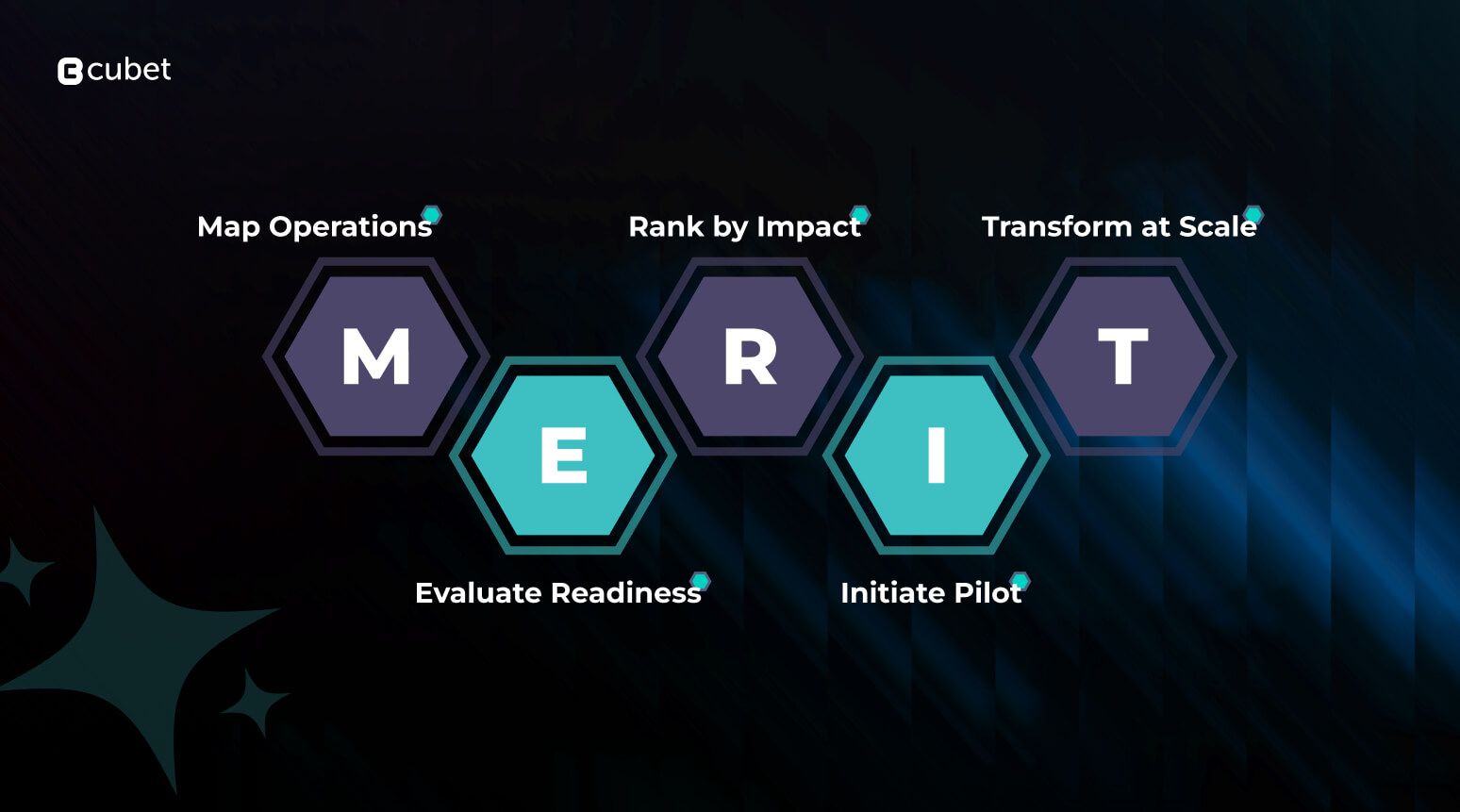
The MERIT Framework was designed to help enterprises identify, validate, and prioritise AI opportunities before engineering begins. Rather than starting with tools or implementation, MERIT introduces a structured evaluation layer that aligns AI initiatives to operational value, feasibility, and measurable business outcomes. It shifts AI adoption from assumption-led experimentation to business-aligned execution.
M — Map Operations
Understand how the business currently operates and identify where operational value is created or lost. This stage covers workflow analysis, operational bottleneck identification, repetitive task mapping, decision dependency analysis, and value leakage assessment. Outputs include a current-state workflow map, identified operational inefficiencies, and AI opportunity areas across functions.
E — Evaluate Readiness
Evaluate whether the organisation's systems, data maturity, infrastructure, and operational environment can realistically support AI implementation. This stage covers data maturity evaluation, existing platform assessment, infrastructure review, integration complexity analysis, and operational readiness assessment. Outputs include a feasibility report, system readiness evaluation, and constraint analysis.
R — Rank by Impact
Determine where AI investment should begin based on measurable business impact and execution feasibility. Use cases are evaluated against business value potential, speed to ROI, operational scalability, strategic alignment, and implementation feasibility. Outputs include a prioritised AI use case roadmap, an impact vs. effort matrix, a recommended execution sequence, and a leadership decision framework.
I — Initiate Pilot
Convert the highest-priority opportunity into a pilot-ready initiative with defined business objectives and measurable outcomes. This stage covers pilot scoping, KPI definition, success measurement planning, operational alignment, and investment justification. Outputs include a pilot-ready scope document, execution roadmap, success measurement framework, and defined investment case.
T — Transform at Scale
Scale validated AI initiatives across the organisation with governance, operational integration, and measurable performance tracking. This stage covers enterprise rollout planning, AI governance, workflow integration, team enablement, and continuous optimisation. Outputs include an AI transformation roadmap, governance structure, scaling strategy, and operational performance framework.
What Changes After a Structured Diagnosis
Running through a structured AI diagnosis changes how organisations make decisions. Instead of moving from idea to pilot to confusion, leadership moves toward diagnosis to prioritisation to execution.
At the end of the process, organisations typically leave with clarity on where AI creates measurable business impact, prioritised use cases ranked by value and feasibility, defined pilot scopes with expected outcomes, a structured implementation roadmap, and a clear understanding of what not to build.
That final point matters. Because the costliest AI initiatives are often not failed deployments. They are the initiatives that should never have been approved in the first place.
The Engagement Model
Step 01 — Discovery Sprint
The entry point for all new AI engagements. A structured consulting sprint focused on diagnosing AI potential, identifying value concentration areas, and prioritising opportunities. Includes workflow analysis, platform audit, AI opportunity mapping, feasibility assessment, prioritisation workshops, and pilot recommendations.
Step 02 — AI Pilot Program
Validate the highest-impact workflows identified during discovery through controlled implementation and measurable KPI tracking. Includes pilot development, controlled implementation, operational validation, KPI measurement, and stakeholder review. The focus shifts from strategy to measurable operational ROI.
Step 03 — Transformation
Scale validated AI capabilities across the organisation through structured governance, process redesign, and operational integration. Includes enterprise-wide rollout, AI governance, process redesign, team enablement, and long-term consulting support. Transformation begins only after pilot ROI is validated.
Final Thought
Most AI bets fail because organisations start with engineering before they establish clarity.
The enterprises that succeed with AI are rarely the ones building the most. They are the ones diagnosing better.
Because the real competitive advantage in AI is not access to technology. It is knowing where the technology creates measurable business leverage — before investment begins.

Mathews Abraham
VP - Revenue & Growth





Get in touch
Kickstart your project
with a free discovery session
Describe your idea, we explore, advise, and provide a detailed plan.