AI ROI: Shouldn’t we measure it?


Artificial Intelligence has moved far beyond experimentation. Today, organizations are investing in AI-powered copilots, Agentic Workflows, document intelligence platforms, customer support assistants, predictive analytics, and autonomous agents to improve efficiency and gain a competitive advantage.
Yet despite the growing investment, one question continues to dominate conversations between business leaders and technology providers:
“What ROI can we expect from AI?”
It’s a fair question. After all, every business investment is expected to deliver value. However, when it comes to AI, many organizations approach ROI the wrong way.
They focus on the cost of the technology before understanding the value of the problem it solves.
The result? Unrealistic expectations, disappointing outcomes, and AI projects that struggle to demonstrate business impact.
The organizations seeing the greatest success with AI aren’t necessarily investing the most money. They’re investing in the right opportunities and measuring the right outcomes.
The Biggest Mistake Organizations Make
When evaluating an AI initiative, most discussions begin with technology.
Questions such as:
Which AI model should we use?
Should we choose OpenAI, Anthropic, or an open-source model?
How much will development cost?
What will the monthly subscription fees be?
While these questions are important, they shouldn’t be the starting point.
The first question should be:
“What business problem are we trying to solve?”
AI itself does not generate ROI.
Business improvements generate ROI.
If an AI solution reduces a process from four hours to thirty minutes, the ROI comes from the time saved. If it helps a sales team respond to customers faster, the ROI comes from increased conversions. If it reduces compliance risks, the ROI comes from avoiding costly penalties.
The technology is simply the enabler.
Why Measuring AI ROI Is More Difficult Than Traditional Projects
Traditional software projects typically have clearly defined outcomes.
For example:
Replace a legacy application.
Automate a manual workflow.
Improve reporting capabilities.
AI projects introduce additional variables.
Success often depends on:
Data quality
User adoption
Business process maturity
Knowledge availability
Employee training
Ongoing optimization
A technically successful AI implementation can still fail to generate meaningful business value if users don’t adopt it or if the organization fails to integrate it into everyday workflows. This is one reason why responsible AI vendors rarely guarantee a specific ROI before implementation.
There are simply too many variables outside their control.
The Difference Between AI Success and Business Success
One of the most common mistakes organizations make is measuring AI success using technical metrics.
Examples include:
Model accuracy
Number of prompts submitted
Number of active users
Response times
These metrics may indicate that the system is working, but they don’t necessarily indicate business value. Business leaders should focus on outcomes instead.
Examples include:
Reduction in manual effort
Faster turnaround times
Increased employee productivity
Improved customer satisfaction
Higher sales conversion rates
Reduced operational costs
Lower compliance risks
These are the metrics that ultimately matter.
Establish a Baseline Before You Build
One of the simplest ways to improve AI ROI measurement is to establish a baseline before implementation begins.
Unfortunately, many organizations skip this step.
Consider a customer support team implementing an AI assistant. Without a baseline, how do you know whether the solution delivered value?
Before implementation, organizations should measure metrics such as:
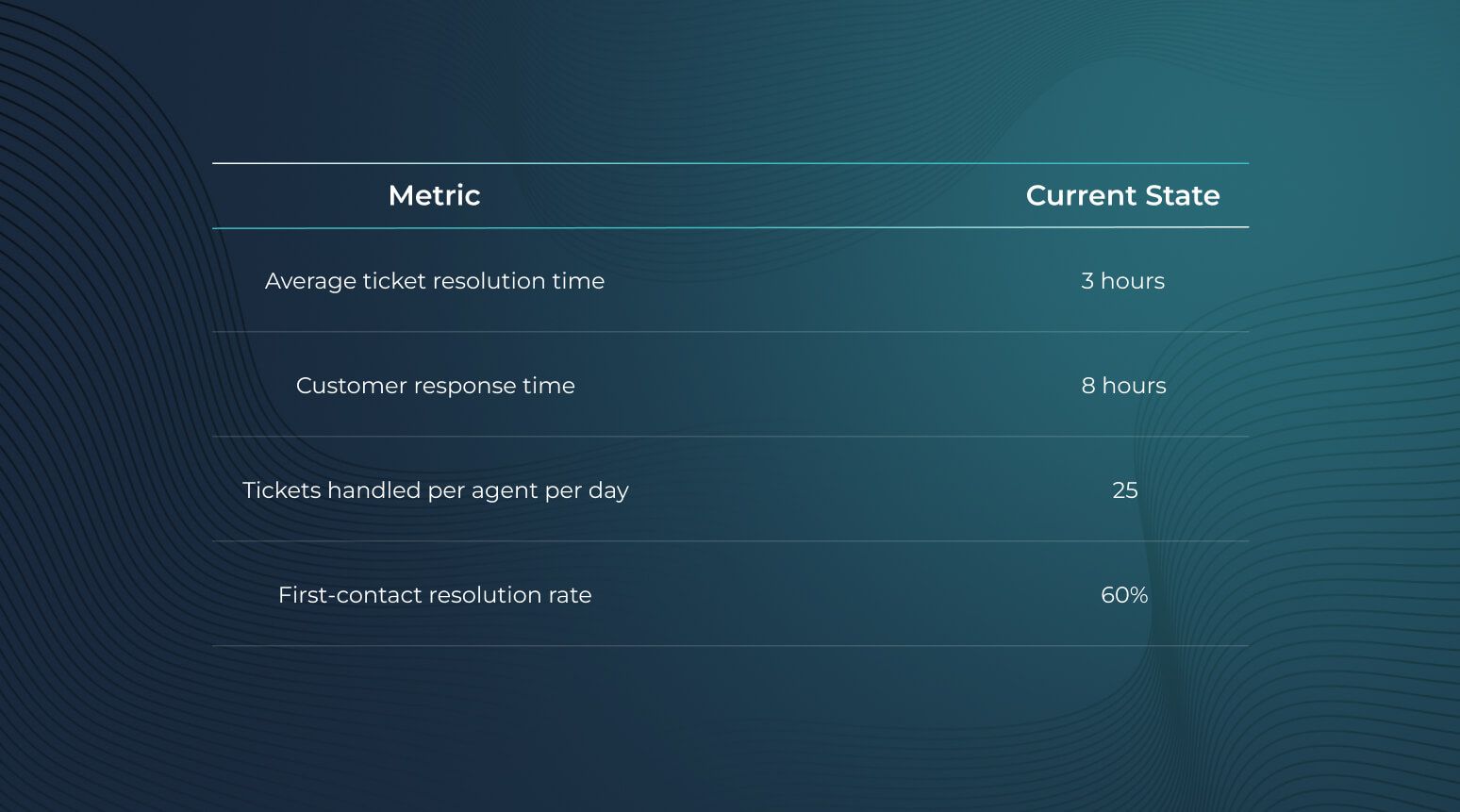
After deployment, improvements can be measured objectively.
Without baseline data, ROI discussions quickly become subjective opinions rather than measurable business outcomes.
The Four Types of AI ROI
When evaluating AI opportunities, organizations should think beyond simple cost savings.
1. Cost Reduction
This is often the easiest benefit to quantify.
Examples include:
Reduced manual processing
Lower outsourcing costs
Fewer repetitive administrative tasks
Reduced support workload
These savings typically produce the quickest and most visible ROI.
2. Productivity Improvement
Not every benefit results in reduced headcount.
In many cases, AI enables employees to accomplish more work within the same amount of time.
Examples include:
Faster proposal creation
Automated document summarization
Accelerated software development
Reduced research time
These productivity gains often create substantial long-term value.
3. Revenue Growth
This is where AI can become transformational.
Examples include:
Faster sales responses
Better lead qualification
Personalized customer experiences
Intelligent recommendations
Organizations that focus only on cost savings often overlook the revenue-generating potential of AI.
4. Risk Reduction
Some of the most valuable AI projects don’t directly generate revenue or reduce costs.
Instead, they reduce risk.
Examples include:
Compliance monitoring
Fraud detection
Cybersecurity threat analysis
Quality assurance automation
Avoiding a single major incident can often justify an AI investment many times over.
What Vendors Can Realistically Commit To
A common question during sales discussions is:
“Can you guarantee the ROI?”
The honest answer is that no responsible vendor can guarantee business outcomes that depend on organizational behavior.
What vendors can commit to are measurable performance indicators such as:
Accuracy levels
Processing times
User adoption targets
Service availability
Security controls
Continuous improvement plans
The organization’s leadership, processes, and users ultimately play an equally important role in determining ROI.
AI success is a partnership, not a purchase.
Why Every AI Project Should Begin with ROI Discovery
Before investing significant money in development, organizations should spend time identifying where the greatest opportunities exist.
This process, often referred to as an ROI Discovery Workshop, focuses on questions such as:
Which processes consume the most time?
Where are employees spending effort on repetitive tasks?
What customer pain points create delays?
Which business activities are difficult to scale?
Where can AI deliver measurable improvements?
The goal isn’t to identify where AI can be used.
The goal is to identify where AI can create value.
This distinction is critical.
Many organizations successfully deploy AI technology but fail to achieve meaningful business outcomes because they started with the technology rather than the business problem.
AI Is Not a One-Time Investment
Another misconception is that ROI should be measured immediately after deployment.
The reality is that AI systems improve over time,
Knowledge bases grow.
Prompts are refined.
Users become more comfortable with the technology.
Additional workflows are automated.
Many organizations see modest returns during the first few months, followed by significantly greater returns as adoption increases and the solution matures.
The most successful AI initiatives are treated as ongoing business capabilities rather than one-time technology projects.
Focus on Value, Not Cost
Businesses often ask: "How much will AI cost?”
A better question is: “How much value can AI create?”
The answer changes the conversation entirely.
When organizations focus solely on implementation costs, AI becomes another technology expense.
When they focus on measurable business outcomes, AI becomes a strategic investment.
The companies achieving the greatest success with AI are not the ones chasing the latest models or trends.
They are the ones that clearly define the business problem, establish measurable goals, track outcomes, and continuously improve.
Because ultimately, AI ROI is not about how advanced the technology is.
It’s about how effectively it helps organizations achieve their business objectives.
Conclusion
At Cubet, we help organizations move beyond AI experimentation and focus on measurable business outcomes. Our approach combines technology expertise, business process understanding, and practical implementation experience to ensure AI initiatives are aligned with real business goals-not just technical possibilities.
Whether you’re evaluating your first AI initiative or looking to scale existing investments, the conversation should always start with one question:
What business value are we trying to create?

Vipin Chandran
Chief Technology Officer, Cubet





Get in touch
Kickstart your project
with a free discovery session
Describe your idea, we explore, advise, and provide a detailed plan.