Using AI in Full-Stack Development Without Losing Your Engineering Judgement


AI tools like Copilot, ChatGPT, and other code-generation assistants have become a natural part of many development workflows. They're embedded in our editors, ready to complete boilerplate or generate test scaffolding with little to no effort. For most developers, especially in fast-paced product teams, these tools are now part of how we keep up.
The Velocity Trap
It’s tempting to see this as a clear win: code gets written faster, and repetitive patterns disappear. But if you’ve spent enough time debugging production systems, you start to see the trade-offs. It’s not just about moving faster; it’s about whether we still understand the systems we're building. As one developer put it: “I’m shipping more, but I don’t know if I’m learning as much”.
Code Isn’t the Hard Part. Understanding Is
The real difficulty in full-stack work is managing cognitive load: balancing front-end state, backend APIs, database behavior, and system constraints. AI tools fill in the blanks, but that same convenience makes them risky. They don’t understand your architectural boundaries or production constraints, and they don’t care if they introduce technical debt.
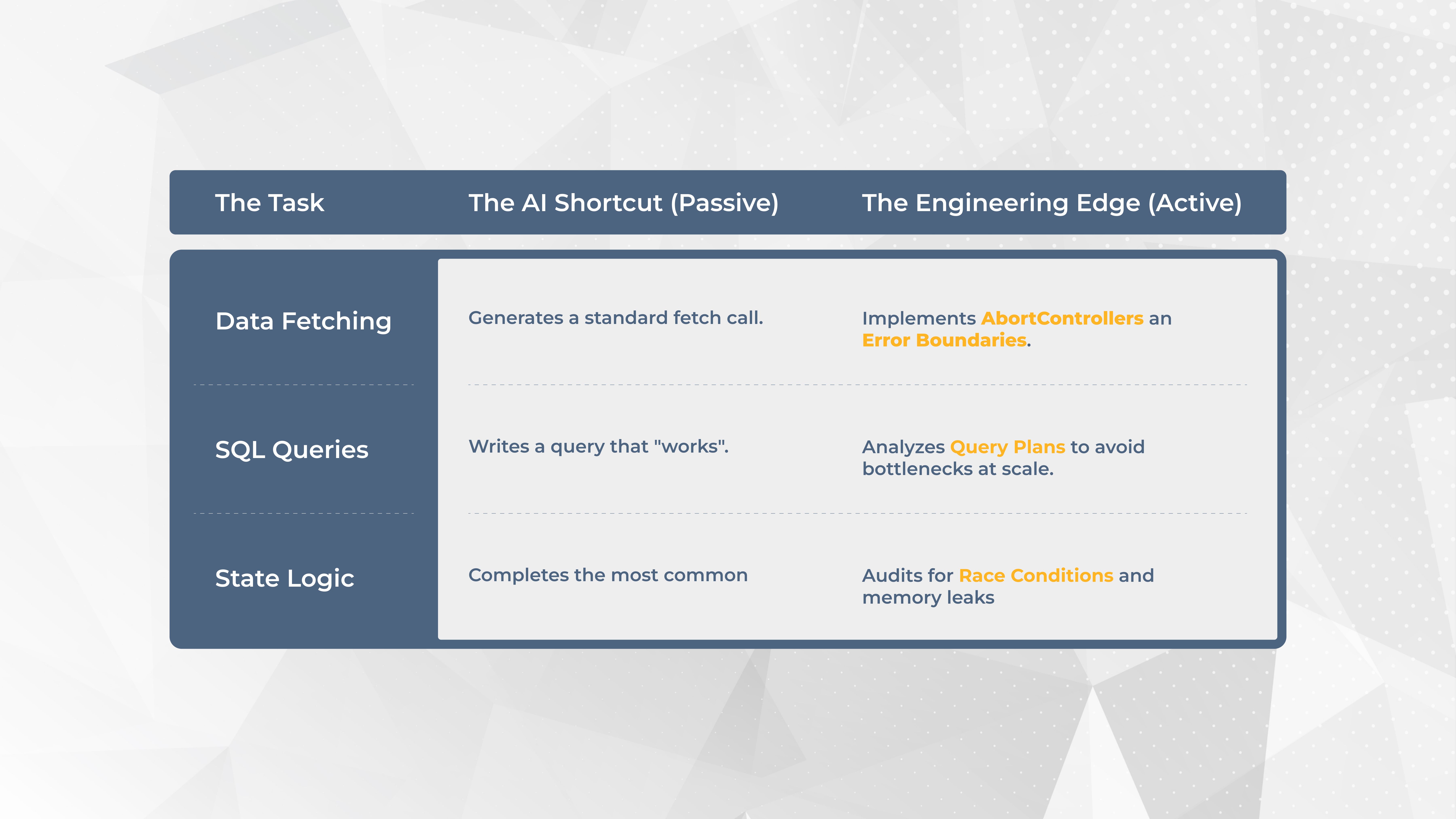
What We Lose When We Stop Thinking
Used poorly, AI tools chip away at skills subtly over time. You stop asking where failure points are or noticing performance bottlenecks. We’ve seen production issues rooted in auto-generated code that violated data flow rules or created edge cases that went unnoticed for weeks. AI doesn’t stop you from being critical, but it makes it easier to be passive.
Use AI Like You Would a Junior Developer’s Draft
The best way to treat AI-generated code is like a suggestion from a teammate who’s still learning.
Review and Rewrite: Don't accept it blindly; check that it aligns with your design constraints.
Verify Boundaries: You must still understand the data model, auth flows, and error handling
Accountability: Ask: "Would I trust this solution if I had to explain it in a design review?".
Make It a Team Culture
At Cubet, we use AI to support engineering, not replace it. We stay sharp through these high-discipline habits:
"No-Tool" Days: We occasionally work without assistance to reveal gaps and refocus on fundamentals.
"Why," Not "What": Use code reviews to talk about the reasoning, including what was considered and rejected.
Clear Constraints: Don’t ask for full implementations; ask for trade-offs to keep architectural control.
Dev Notes: We encourage writing notes on where AI was used and what still needs revisiting.
Conclusion: What Good Looks Like
Great engineers don’t just ship code; they own outcomes. They can explain why a fix works, know what corners were cut, and predict where things will fail. AI doesn’t lower the bar; it just makes it easier to forget where it is.
Use the tools, but don’t outsource your thinking. We invest in systems that scale because the people building them know exactly how they work.
Building with AI doesn’t mean letting go of engineering discipline.
If you’re thinking about how to balance both in your team, we’d be happy to share how we’re approaching it at Cubet.

Arjun V D
Senior Software Engineer





Get in touch
Kickstart your project
with a free discovery session
Describe your idea, we explore, advise, and provide a detailed plan.